When onboarding and personalization can be done inside the product, should AI SaaS companies even bother with email marketing like “conventional” SaaS businesses?
We talked to marketers about the challenges and opportunities in email marketing for AI companies, how to market to AI users, and what content users prefer at different stages in their lifecycle.
Meet our experts:
- Jonathan Kvarfordt, founder and CEO of GTM AI Academy
- Anna Aria Harutyunyan, senior CRM manager at VEED
- Alix Gallardo, co-founder and GTM at Invent
- Auroriele Hans, email strategist and founder of AuthorityScribe
- Osnat Lidor, B2B growth marketer and owner of Demand Gen Studio
- Sangeetha Iyer, marketing lead at Touchstorm DATAlabs
- Rachael Pilcher, founder of Mighty Fine Copy
Don’t wait for the muse. Apply this step-by-step method to write high-performing email campaigns in hours, not weeks.
The difference between traditional SaaS and AI-native platforms
We’ve seen lots of big and small SaaS tools plaster “AI-powered” on their homepages.
But what’s the difference between SaaS and AI-native tools?
GTM AI Academy CEO Jonathan Kvarfordt gives a simple analogy to differentiate AI-powered SaaS and AI-native tools based on their core architecture:
“Traditional SaaS: Like adding smart features to your car.
AI-Native: Like having a self-driving vehicle from the start.”
This means that bolting AI onto a SaaS product doesn’t make it AI-native. A SaaS product may incorporate AI features, but AI isn’t core to its functionality or value.
Meanwhile, AI-native products are built from the ground up with generative AI or machine/deep learning AI at their core. Without AI, the product cannot function.
Benchmarkit CEO Ray Rike did a deep dive into the difference between SaaS and AI-native software.
Should AI companies bother with email marketing?
Touchstorm DATAlabs’ Sangeetha Iyer says that a lot of AI-first companies make the mistake of deciding that they don’t need to send emails:
“A lot of AI-first companies conclude they don’t need email.
But what actually happens are weaker activation, poor retention, and no reinforcement of value delivered. Because AI is good at optimizing interactions, not understanding the human behaviour behind the scenes.”
She adds that compared to traditional SaaS, email plays a leaner and more specific role for AI-first companies:
“Email is moving from a continuous conversation channel to a high leverage intervention channel. That’s a meaningful difference in how you’d think about what to send and when.”
Sangeetha says AI might replace emails in these a few areas such as:
- Onboarding. The product can now handle the process in real time.
- Nurture sequences. These are being replaced by ongoing product interaction.
- Segmentation. Segments are replaced by per-user personalization that updates continuously.
But email cannot be replaced in these areas:
- Re-engagement. When users leave your product, AI can’t follow them. Email can.
- Value reinforcement. AI products often do a lot without communicating it. An email that says “here’s what you got done this week” builds perceived value in a way the product often doesn’t.
- Narrative. AI optimizes individual interactions but it doesn’t tell a coherent story. Email is where you frame the journey, explain the “why” and add a human layer, especially early on.
- Cross-session meaning. Your product sees moments. Email connects them into something the user can understand.
Unique challenges in email marketing for AI companies
The “aha” moment is harder to define
Rachael Pilcher of Mighty Fine Copy shares that unlike traditional SaaS, you can’t define a concrete and specific “aha” moment for AI-native tools:
“The ‘aha’ moment for SaaS users tends to be more concrete. But with AI, it isn’t any one specific thing that moves a new user to finding value in the product.
For example in SaaS, your typical ‘aha’ might be the first integration that was connected, or the first invoice that was sent. You can easily track that moment, trigger an email, and celebrate this with a user.
But with AI products, it’s not easy to find any specific moment to track. A user might get a better output than they expected on a random day, or solve something they weren’t sure the tool could handle. So there’s nothing concrete to pinpoint, and you’re not always sure what you’re supposed to be guiding users towards as their ‘aha’ moment.”
AI users are more skeptical
AuthorityScribe’s Auroriele Hans shares that users are more skeptical because of the exaggerated claims about AI’s capabilities:
“Users are skeptical of AI tools because of hyperbolic marketing claims like, ‘Say goodbye to your copywriter,’ or ‘Replace your humans,’ especially because the reality of using many of these tools is the complete opposite: endless re-prompting and refining. Customers have been let down too many times.”
She addresses this by setting realistic expectations and handling objections in emails:
“Don’t overpromise and handle objections in your product announcements. That’s what I did for a leading headless CMS and composable digital experience platform.
For example, I emphasized that better inputs (customer data pulled from their digital properties) and a brand kit would ensure their outputs were personalized and on-brand. I underscored the time savings of spinning up a first draft that they could then improve upon. Explaining how the product overcame common generative AI issues and setting realistic expectations led to faster adoption and lower churn.”
Keeping users informed without overwhelming them
Alix Gallardo, co-founder of Invent, says AI SaaS companies need to strike a balance between building trust and excitement with users versus bombarding them with information:
“Your audience might range from tech enthusiasts to total beginners, so you have to explain enough about the technology to build trust and excitement, but not overwhelm people with jargon or too technical details.
AI products also evolve pretty fast and keeping users informed without overwhelming them is challenging as we ship something every 2-3 days. We usually send one weekly newsletter to our list.”
Addressing the “AI going rogue” fears
We’ve seen one too many stories of AI agents wiping out entire databases, making the fear over AI going rogue understandable.
Demand Gen Studio’s Osnat Lidor says this makes assurance an important element in AI communication, especially for B2B:
“A challenge that is unique to B2B: companies fear the product will go rogue and derail their processes. Assurance is not a footnote in AI communication. Be explicit that updates are not auto-pushed, that guardrails exist, that they stay in control.”
Cost barrier
For something as complex as AI video production, credits can be expensive. Anna Aria Harutnuyan shares how they address this at VEED:
“AI video credits are expensive and many users want to see real outputs before they invest. We address this through free credit offers and educational workshops where we demonstrate the models live. It shifts the value exchange: instead of asking users to take a leap of faith, we show them what is possible first.”
Opportunities in email marketing for AI companies
Audience genuinely wants to be educated before committing
Anna says their users genuinely want to be educated before committing to the tool:
“Unlike typical SaaS where a free trial does the selling, AI video tools require users to understand what different models are even capable of producing.
Comparative content, think side-by-side outputs of Sora, Veo, Kling, and Fabric 1.0 generated from the same prompt, performs exceptionally well because it answers the question users actually have: ‘What will I get?’ That kind of content earns opens and clicks before a single credit is spent.”
Users are looking for practical guidance and clarity
She also shared that AI is still genuinely hard to use well, thus the strong appetite for practical guidance on using the tools:
“Users want to know how to write prompts that produce consistent characters across clips, how to string short generations into a coherent narrative, and how to avoid the aesthetic pitfalls that most people now recognize as AI slop.
Prompt guides, model release announcements, and workflow walkthroughs are not filler content for this audience. They are the content.”
Osnat says product updates are a great opportunity to give your users clarity in an overwhelming space:
“Email marketing for product updates is an incredible opportunity for AI-first companies. Most of their target audience feel like they cannot keep up with AI.
Product update emails that frame changes as ‘here is what you can now do’ consistently outperform standard updates. You are giving users clarity and excitement about their ability to stay ahead, in an overwhelming space.”
What marketing to AI users looks like
#1. Avoid lazy and generic emails (they’re engagement killers)
Because a lot of AI tools can easily generate emails, Rachael thinks the standards are higher for email than it’s ever been:
“I think AI users are more skeptical of lazy emails. For people who use AI tools every day, the bar for making an email feel like a real human wrote it is higher than it’s ever been. The copy has to feel like it was written for a specific person (or type of person), not populated from a database field, especially if the goal of the email is to sell something.
If your email could have been sent to anyone, an AI user will know it because they could have written it themselves in about 10 seconds.”
Osnat shared that generic messaging is a definite engagement killer:
“What does not work is generic messaging. Users spot it immediately and disengage fast.”
#2. Curation is key
With so many things happening in the AI space, it’s tempting to send an email on every model update and industry news. Anna says the key to creating engaging emails is to curate content:
“The real challenge is curation. AI users are already swimming in content from newsletters, LinkedIn, YouTube, and every other channel. If your emails start to feel like a feed rather than a resource, they will tune out or unsubscribe.
I think the brands that earn consistent engagement are the ones that filter ruthlessly, leading with what is actually useful or genuinely new, and skipping the noise.”
#3. Show the product’s value
Similar to traditional SaaS, marketing and lifecycle emails can help reinforce product usage by showing users the value they can get from the tool.
Alix shares that they always talk about how new features and product updates can help with their users’ end goal:
“Whenever we announce new features or share updates, it’s always with their business success in mind. This means our open rates and CTR are usually high: our users are eager to learn about the latest updates and quick to adopt them to help them grow.”
#4. Be honest and empathetic
AI is still being sold as a magic bullet for a lot of use cases, and users find themselves disappointed when reality doesn’t match their expectations.
Auroriele shares that aside from being honest with them, you also have to empathize with user’s frustrations over AI:
“Don’t oversell what the product can do. Be empathetic with their frustrating journey with AI. Explain how the product overcomes common AI problems. Future pace what work could look like with the tool. And educate them on how to get the most value out of the platform.”
What users want to see in emails from AI companies
Proof that the AI tool works
Gain users’ trust by showing them real outputs, real use cases, and honest comparisons with other AI tools.
Model updates and new capabilities
Compared to traditional SaaS, model updates are genuinely exciting in the AI space because users get a benefit from it.
Anna shares that this email content brings high engagement:
“Model updates land differently in the AI space than in traditional SaaS. When a new AI video model ships, it is genuinely exciting news, not a changelog. That creates a natural rhythm for email campaigns that keeps engagement high without having to manufacture reasons to reach the inbox.”
Instead of a mere update, these changes have to be packaged in a way that communicates what’s changing and shows users the new possibilities with the tool.
Rachael shares how this pulls users back into the product:
“Emails that can show some kind of before and after situation can give users a reason to go back into the AI tool and try something again, which is more hands-on and nudges people back into the product, versus just sending out news roundups or whatever.”
Prompt inspiration
Rachael says that prompt inspiration emails get are more engaging because most users might not be maximizing the AI tool to its full potential:
“Prompt emails work because most AI users typically don’t use a tool to its full potential. If they read an email and think ‘Wow, I never thought to use it that way,’ this can be more valuable to them than reading about a new update.”
Resources and practical guidance
Aside from prompt inspiration, users also like to see resources that could help them with their use cases such as webinar recordings, best practices, and courses. Auroriele shares why:
“Using AI can feel like the wild west. Playbooks get outdated as soon as they’re written because the tools change so much.
Education and support are critical. Most users have a mandate from leadership to use AI. Plus, they want to stand out in a horrible job market. AI companies have to be their trusted sidekicks, guiding and supporting them through a tumultuous user and in real life journey.”
Invitation to in-person events
Anna says AI users also look forward to in-person events because it taps into several motivations:
“Masterclass invitations, live workshops, and community events perform exceptionally well because they offer something email alone cannot: a chance to see the product in action and ask questions in real time. Competitions and challenges tap into a different motivation entirely. They give users a reason to create, share, and push themselves.”
She also shared how this worked well at VEED:
“The in-person element is something we have found particularly powerful. Hackathons at our London and Amsterdam offices, where people come in to actually build with VEED, create a level of product connection that no campaign can replicate. Those events generate their own content, their own community moments, and their own word of mouth.
Email becomes the thread that ties it all together, inviting people in, following up with outputs and highlights, and keeping the community warm between events.”
Types of emails AI SaaS companies should send
Let’s take a look at the email types you should send to your list, what to include in those emails, and real examples from AI companies.
Welcome emails
Aside from welcoming new users to the platform, use these emails to provide practical guidance so users can get started with the tool. These emails can include:
- Prompt inspirations
- Tips and tutorials
- Steps on setting up the tool
- CTAs to try out the tool and/or its specific features
Here’s Google’s welcome email for a new Gemini user:
Subject: Hey [first name], welcome to Gemini
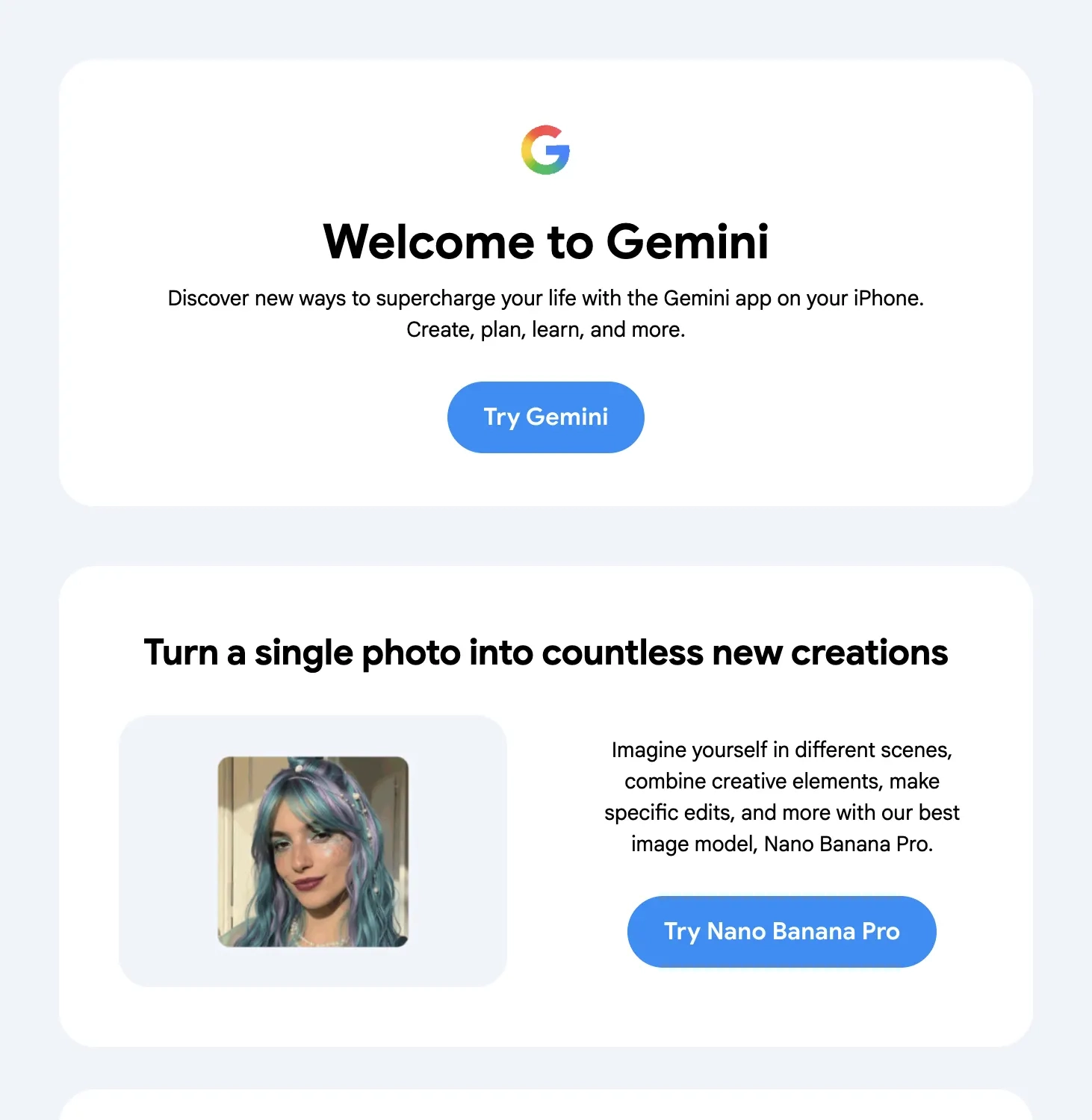
The first section of the email introduces some of Gemini’s features and what the user can do with it. The second section shows several ready-made prompts that the users can immediately try with the tool. The last section contains practical tips on how to get the best responses from Gemini.
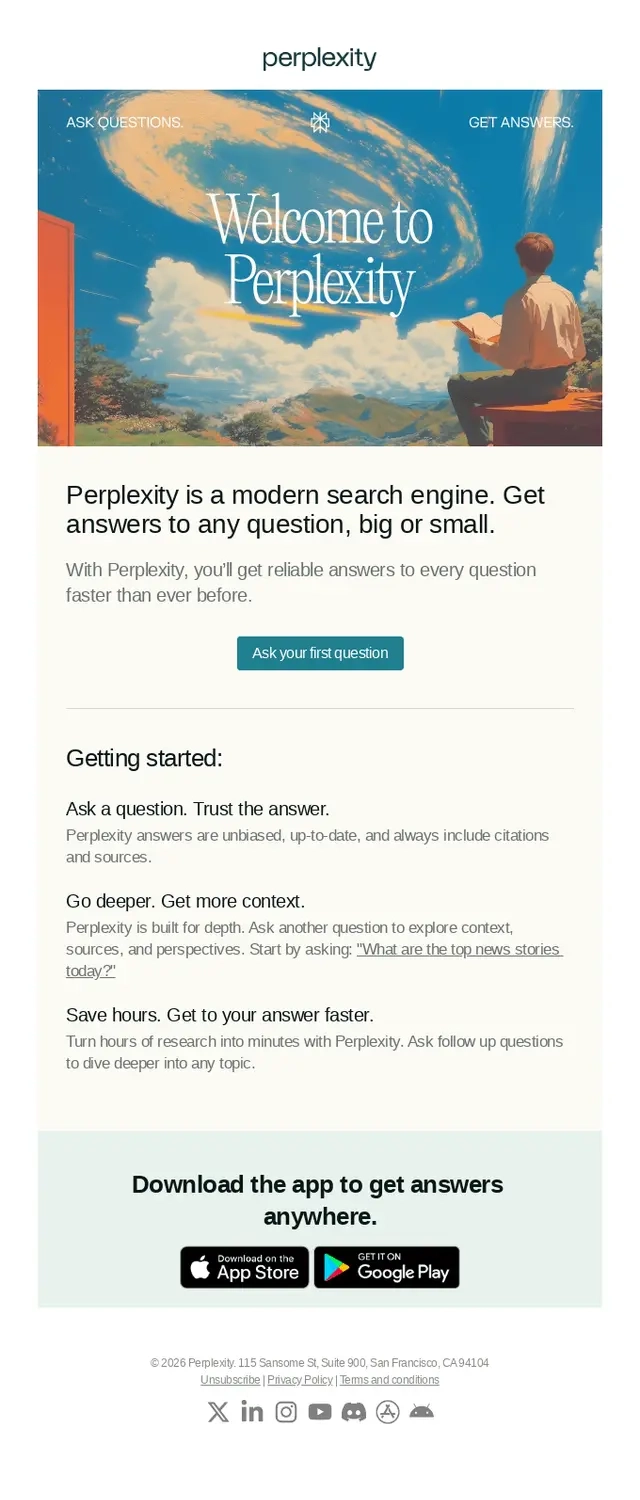
Meanwhile, here is Perplexity’s welcome email:
Subject: Welcome to Perplexity
Source: Really Good Emails
The first half of the email sets expectations by introducing what Perplexity does, followed by a CTA to ask a question. The second half lists a few steps on how to get started with the tool.
And here’s Anthropic’s welcome email for Claude Code:
Subject: Welcome to Claude Code
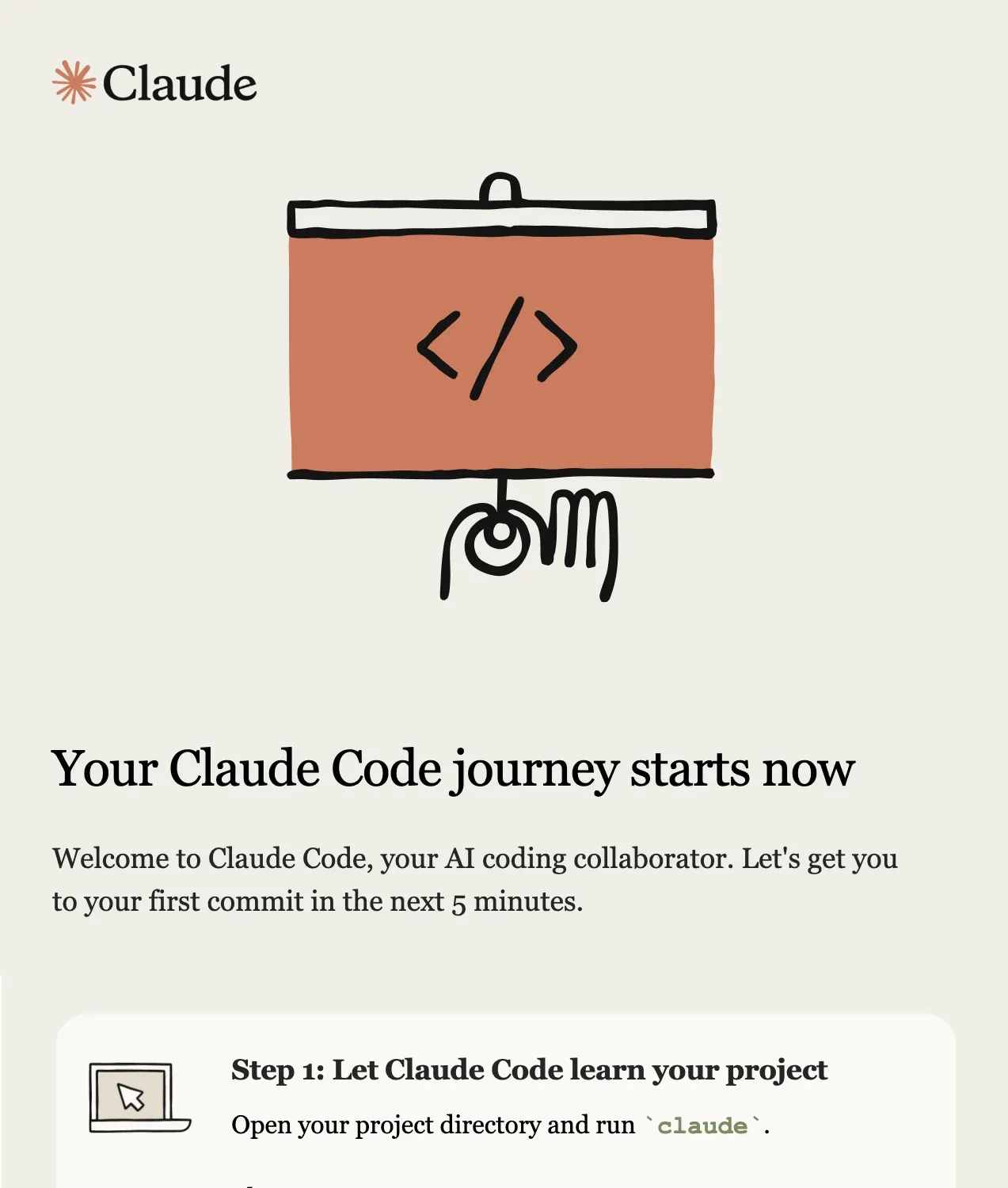
This welcome email lists down detailed steps to help the user ship their first commit in 5 minutes.
Tips and tutorials
Tips and tutorials on platform usage help users take the first step and see the product’s value, which could eventually turn into full adoption.
Here’s an example from OpenAI on getting started on ChatGPT:
Subject: Ask anything – really
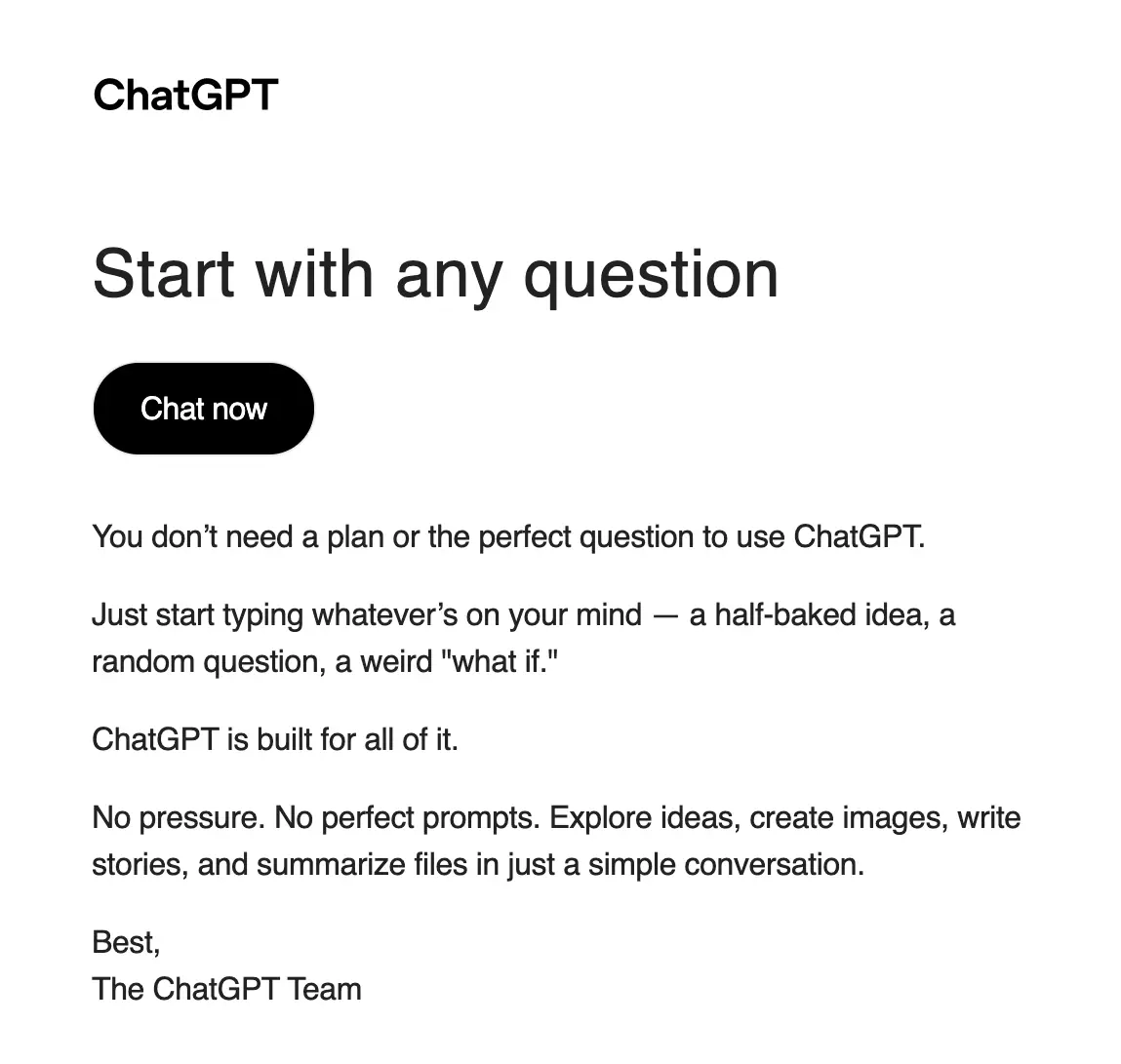
Using AI can be overwhelming to some users, so OpenAI goes with a relaxed and friendly tone. They encourage the user to just start chatting with ChatGPT to remove the pressure of coming up with a perfect question or prompt, reassuring that the platform can handle anything.
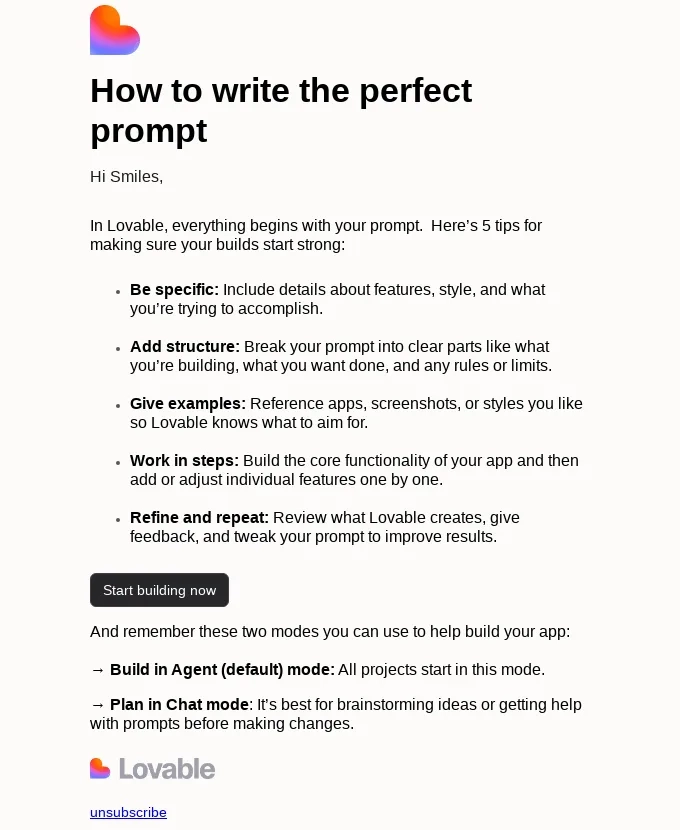
Here’s another example from Lovable.
Subject: How to write the perfect prompt
Source: Really Good Emails
A user might become frustrated if they can’t build a functioning, vibe coded app with Lovable. This email gives five tips on writing the perfect prompt so Lovable can help them with that goal, including a CTA to start building. They also mention that the Build in Agent mode and Plain in Chat mode have different purposes and roles in the app building process.
Prompt inspiration
Most users might not be using the tool to its full potential. Prompt inspiration emails show users new or different ways to use your platform’s capabilities so they can test it out themselves.
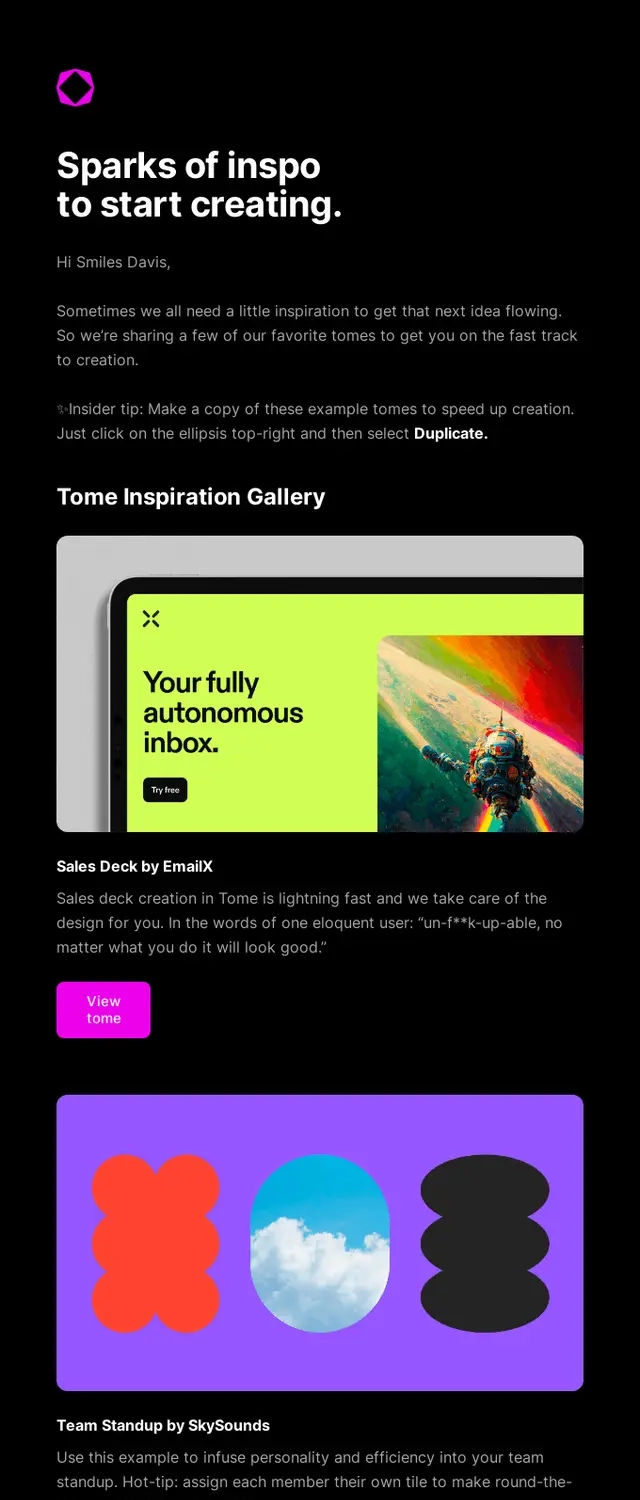
Here’s an example from Tome:
Subject: Get a boost from these Tome examples
Source: Really Good Emails
Their email features several prompts from their community, with each citing a practical use case. They also link to other resources that can help the user get started with Tome.
Model updates
Because it’s the core of the product, AI model updates are done as a separate and dedicated email. By talking about what’s changing and new capabilities that came with the model update, this encourages the user to get back into the product.
These emails usually include:
- Link to the announcement post that contains more details about the model
- Link to a demo video
- CTA(s) to try out the improved capabilities
Here’s OpenAI’s announcement for GPT-5.
Subject: Try GPT-5 for free
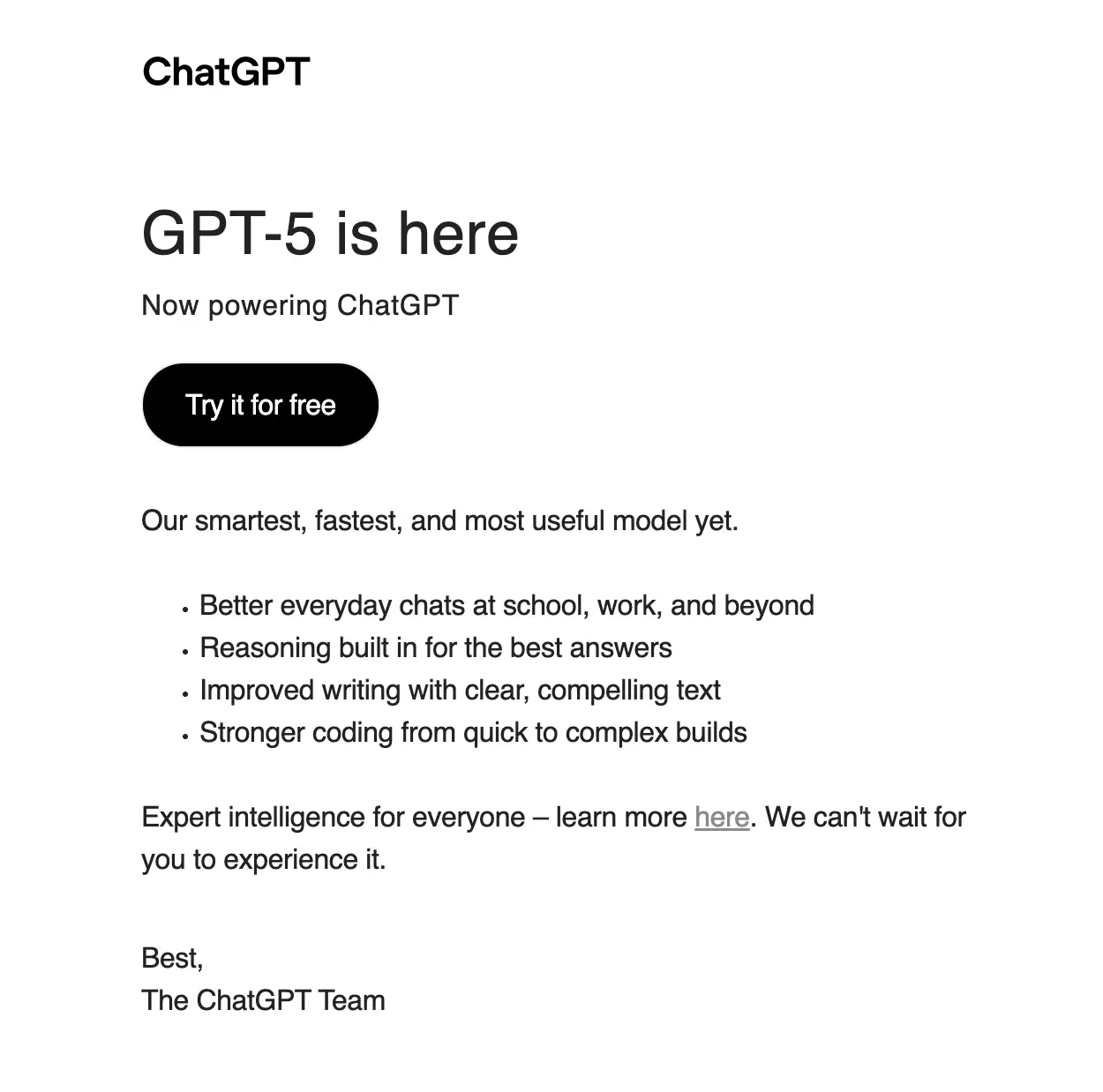
They went with a straightforward email, listing down the improved features and capabilities that come with this model. OpenAI included a text CTA should the reader want to know more about GPT-5.
And here’s Anthropic’s announcement for Opus 4.6.
Subject: Claude Opus 4.6 is here
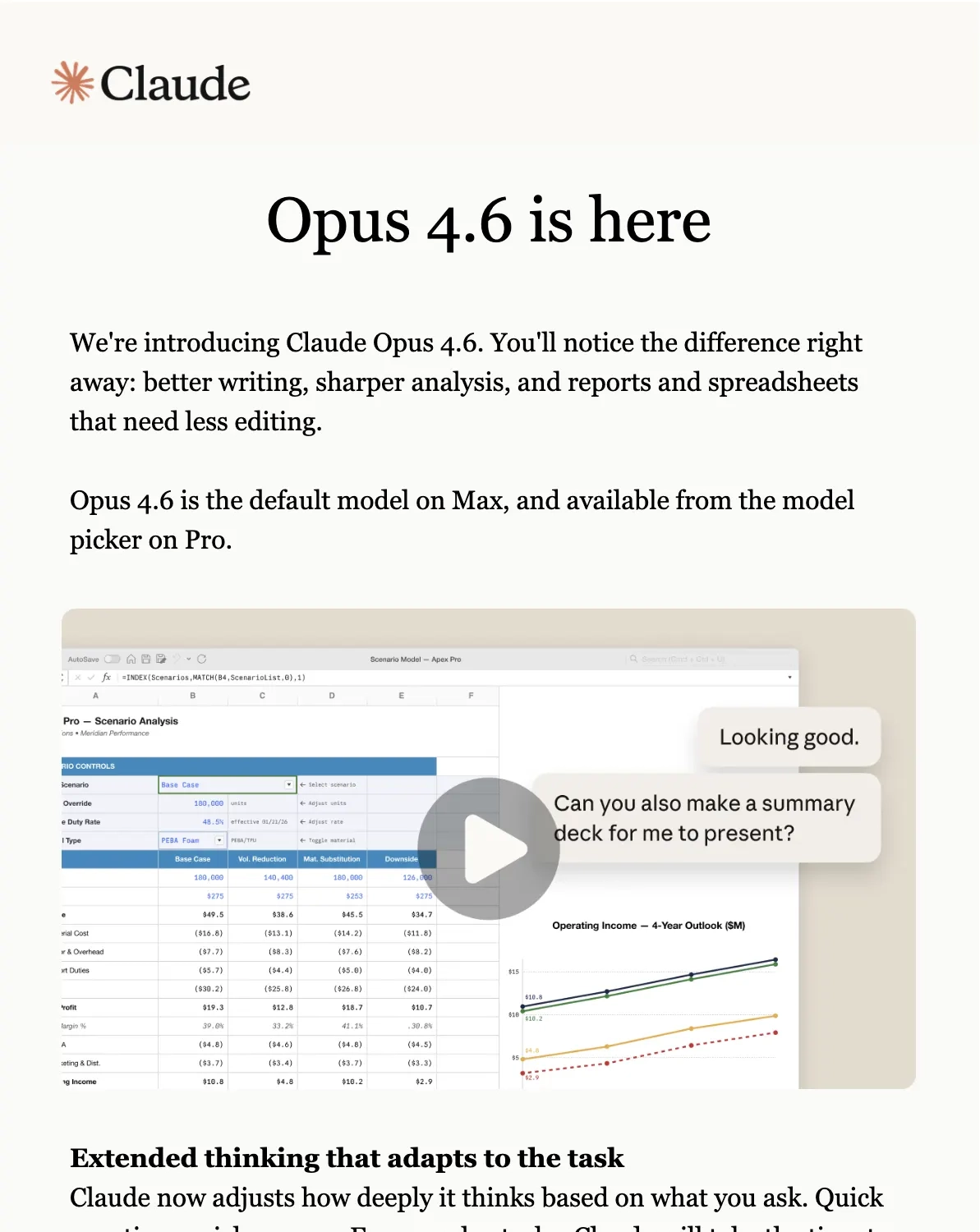
The email starts with a summary of Claude’s improved capabilities with Opus 4.6 and how this model can be accessed by Max and Pro users. This is followed by an image redirecting to a demo video of Opus for subscribers who prefer to watch the summary instead of reading an email.
The second half of the email showcases other features Anthropic has shipped to maximize the new model namely adaptive thinking, Claude Cowork, Claude in Powerpoint, and Excel. The email ends with a CTA to the blog post should the reader want to learn more about the model.
New features and integrations
Similar to model update emails, these emails should show users the new possibilities inside your product and encourage them to try it out.
To introduce a new feature or integration, these emails usually include:
- Product screenshots
- GIFs
- Link to the feature or integration page
- Link to a demo video
- CTA to try the new feature or integration
Here’s an example from OpenAI.
Subject: Meet ChatGPT Images 2.0
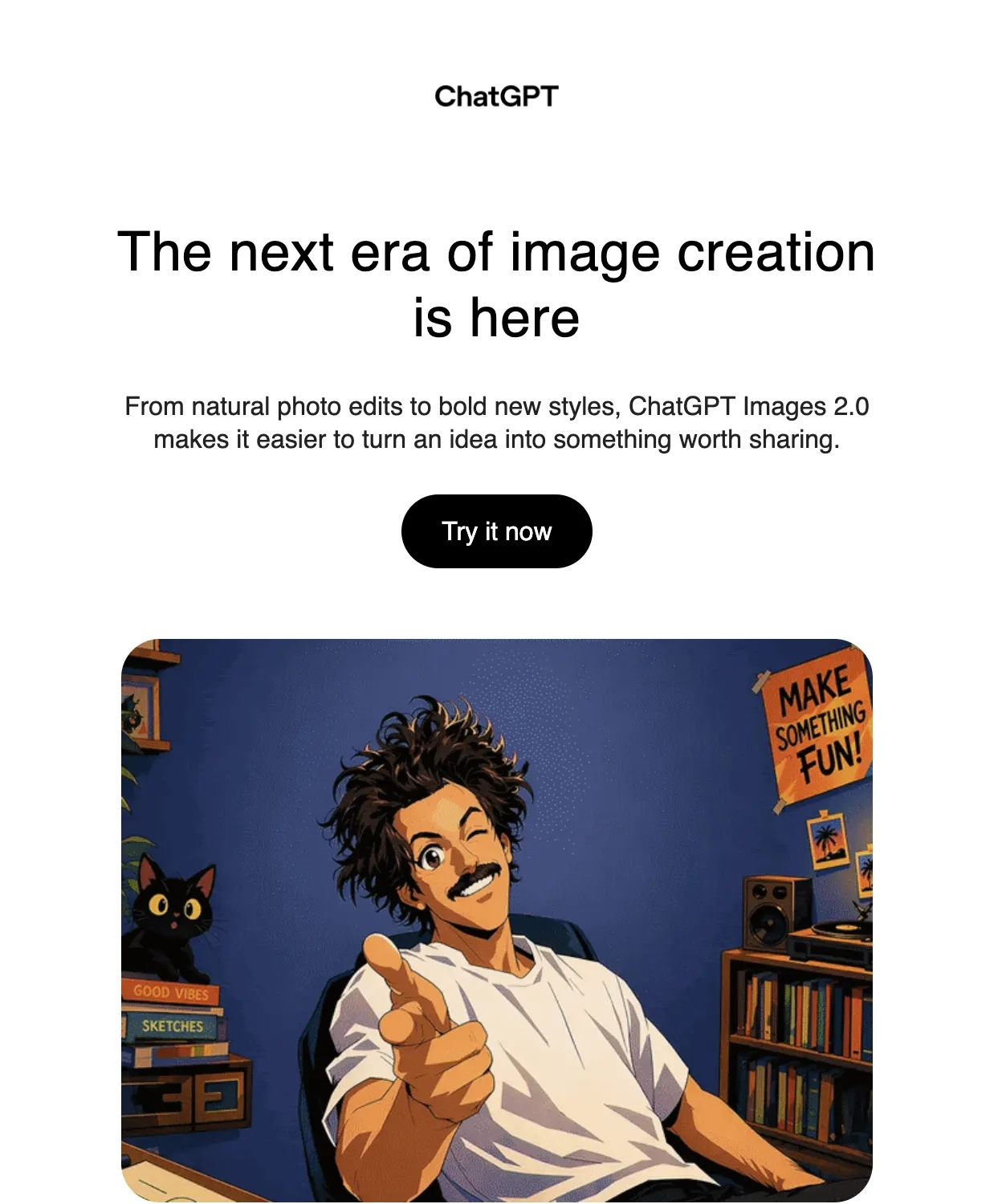
OpenAI shows ChatGPT Images 2.0’s capabilities with a GIF that features images in different art styles to show what a user can do with the new feature:
Their email also includes a CTA to try the feature out.
And here are two examples from Cursor. Thanks to Benedicte Raae for contributing these email examples.
Subject: Introducing Cursor Automations
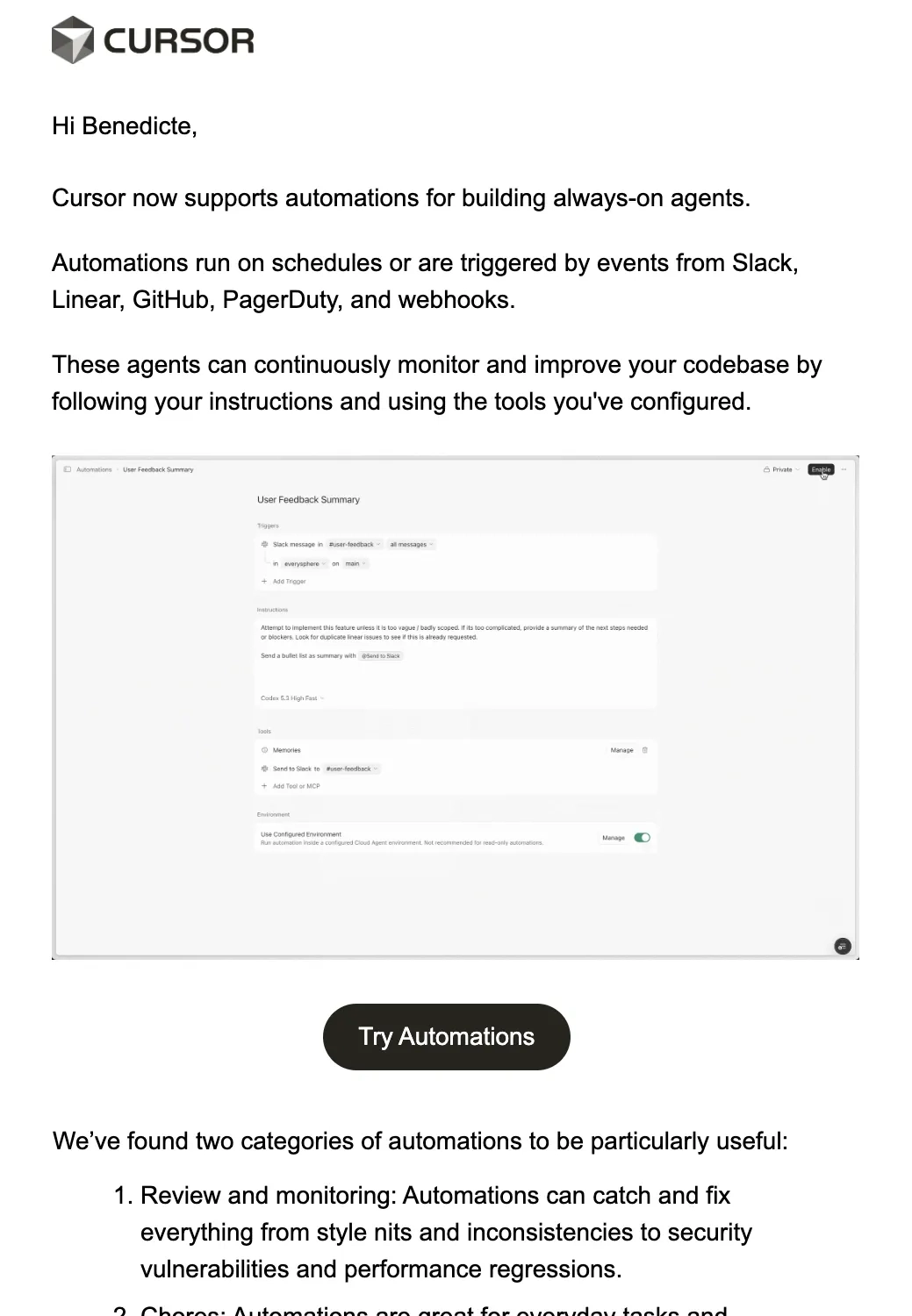
In this feature announcement email for their Automations feature, the first half describes what the new feature does followed by a GIF that illustrates it:
This is then immediately followed by a CTA to try out Automations.
The second half of the email lists two use cases for the feature so users can visualize where they can use this in their workflows. They used another GIF to show how exactly you can schedule chores with Cursor:
They then link to their automations page and a template page to help the user get started with their first automation. They also include a link to the announcement post should the reader want to learn more about the feature.
Subject: Over 30 new plugins join the Cursor Marketplace
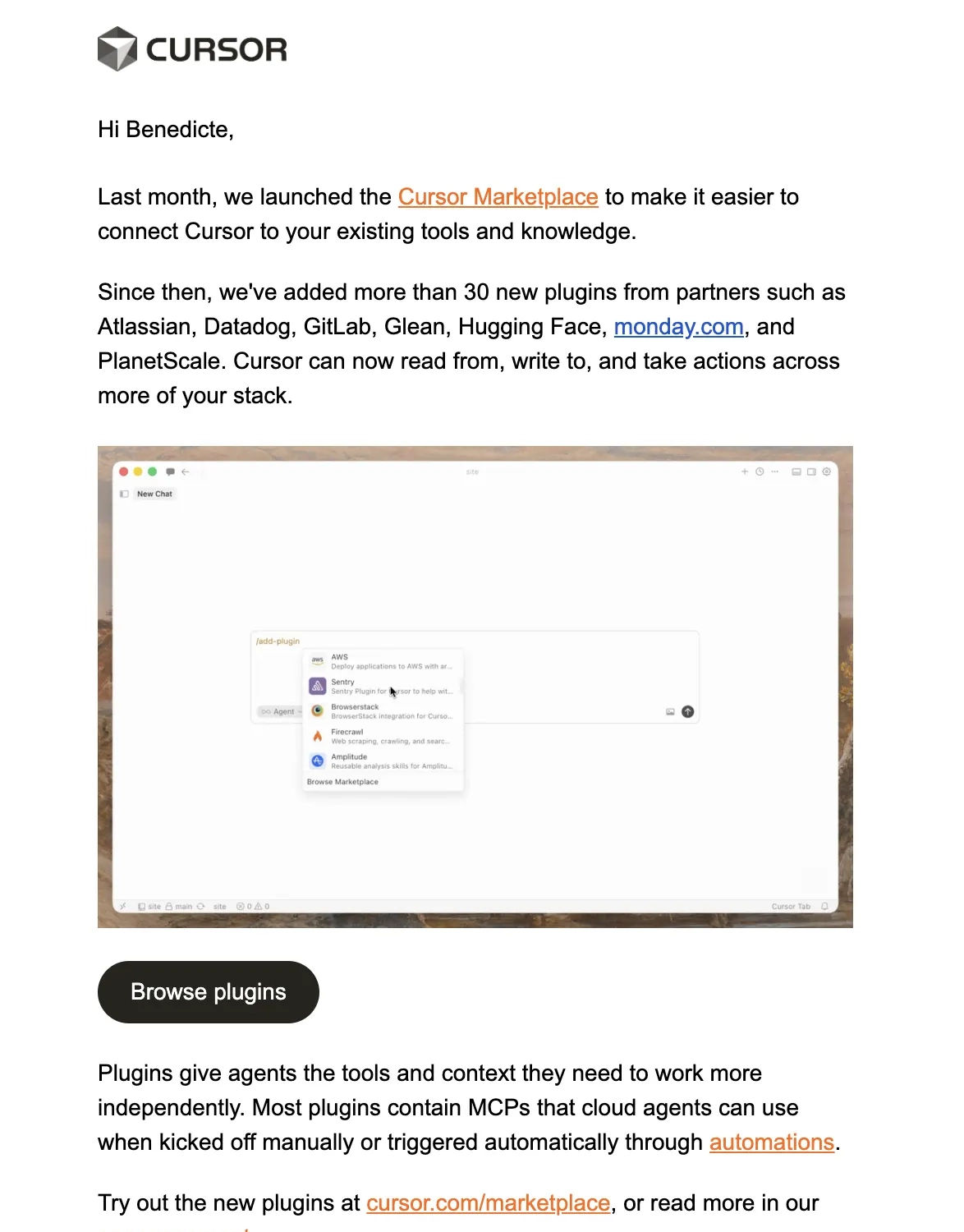
This email talks about the 30 new plugins available for Cursor, mentioning a few of the popular tools that are likely included in their user’s tech stack. They included a GIF showing how exactly to add and search plugins from their marketplace:
This is then followed by a CTA to browse the plugins in the marketplace. And similar to the previous email, they included a link to the marketplace page and the announcement post.
Here’s another example from Anthropic.
Subject: New Claude Features: Introducing Research and Google Workspace
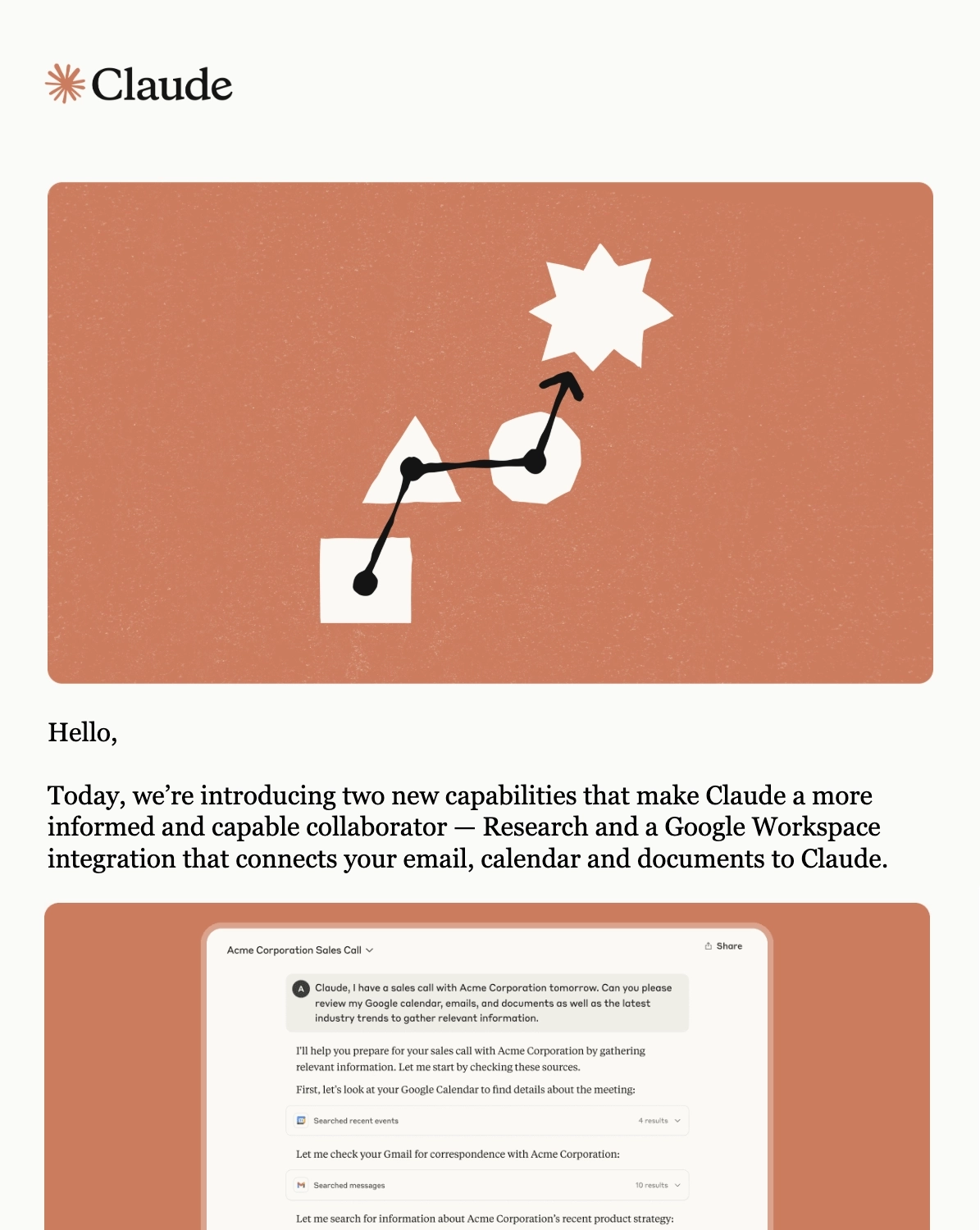
This email is an announcement for one new feature and one integration, starting off with a short description of what you can now do with Claude.
The second section focuses on the research capability, showing a screenshot and a short description of how Claude runs research. They also mention which plan has access to this feature and where this is in beta.
The third section focuses on the Google Workspace integration, mentioning specific use cases on how to improve the user’s workflow. They also mention which plans have access to the integration.
Because both are only available on paid plans, the email ends with a CTA to upgrade.
And here’s an example from Google.
Subject: [First name], create music, try Nano Banana 2, and more
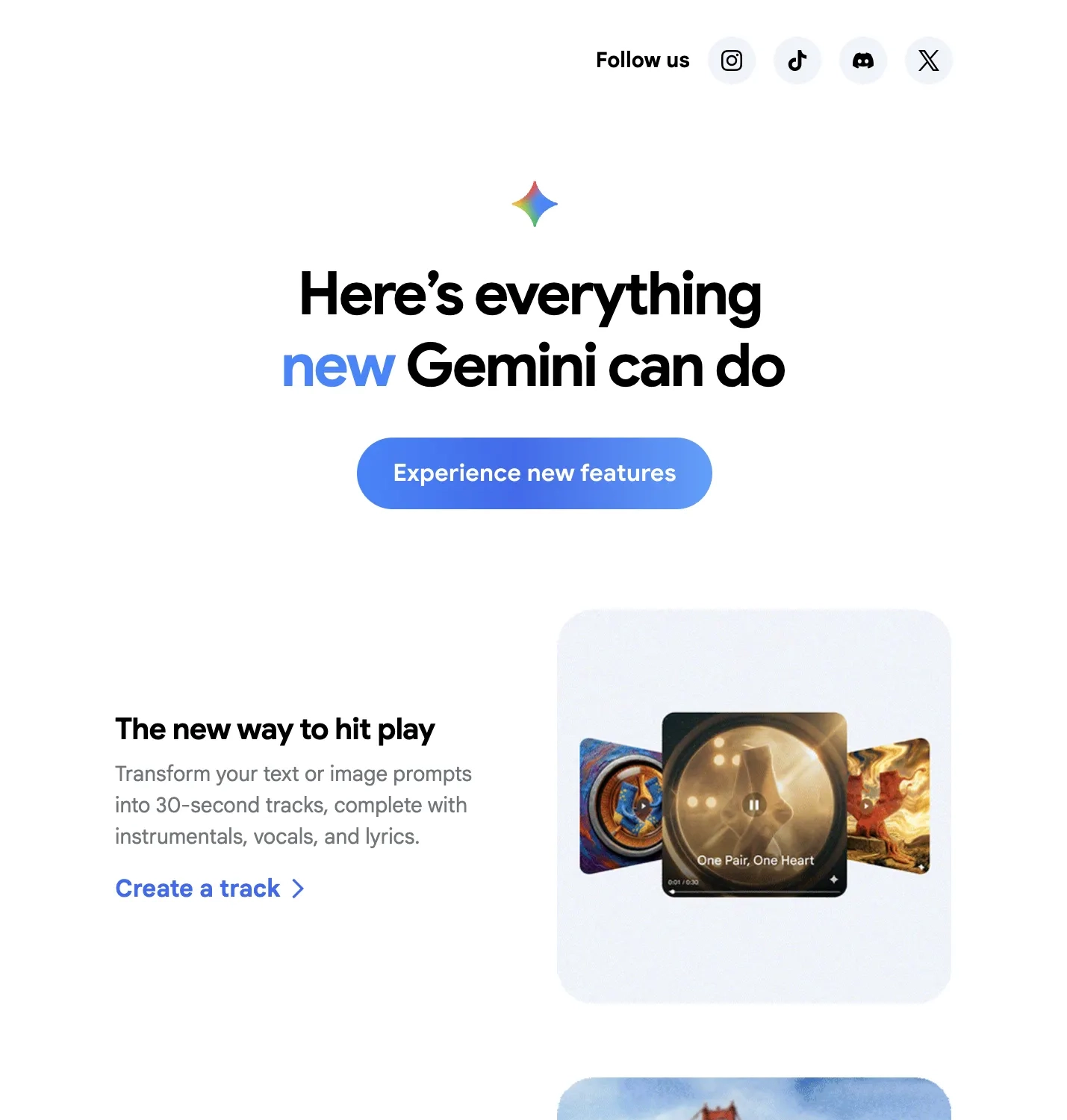
Their new feature roundup email shows three new capabilities users can explore with the new Gemini. Each capability featured comes with a short descriptive blurb, a visual element, and a CTA so the user can try it out themselves.
Don’t wait for the muse. Apply this step-by-step method to write high-performing email campaigns in hours, not weeks.
Newsletters
Getting the right content mix will depend on your audience. You wouldn’t want to overwhelm your subscribers with too much information, so curation is key here.
A newsletter from an AI company can contain:
- Roundup of new features and product updates
- Resources such as blog posts, webinar recordings and courses
- Invitation to in-person events
Let’s see Invent’s newsletters. Thanks to Alix Gallardo for contributing these examples.
Subject: 🔔 Consolidated Billing, Contact Activity and Contact Notes
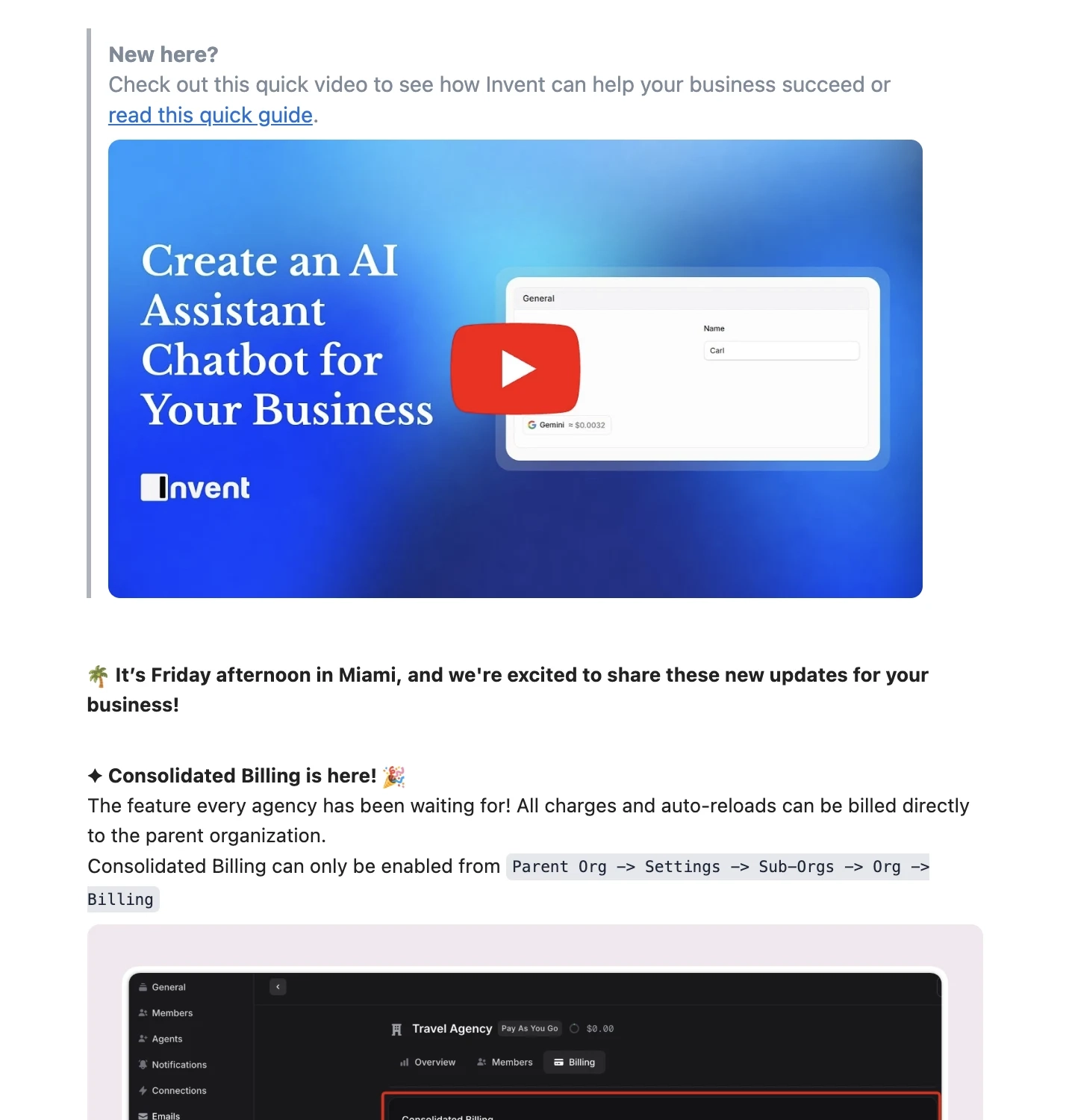
Alix shares that they ship out a few features every week so they send a weekly newsletter that rounds it up for their subscribers. In this edition, they’ve also included a link to a research about response time and conversions.
Here’s another recent newsletter from them.
Subject: 🔔 Referral tracking, Sessions Management and more Efficient Assistants!
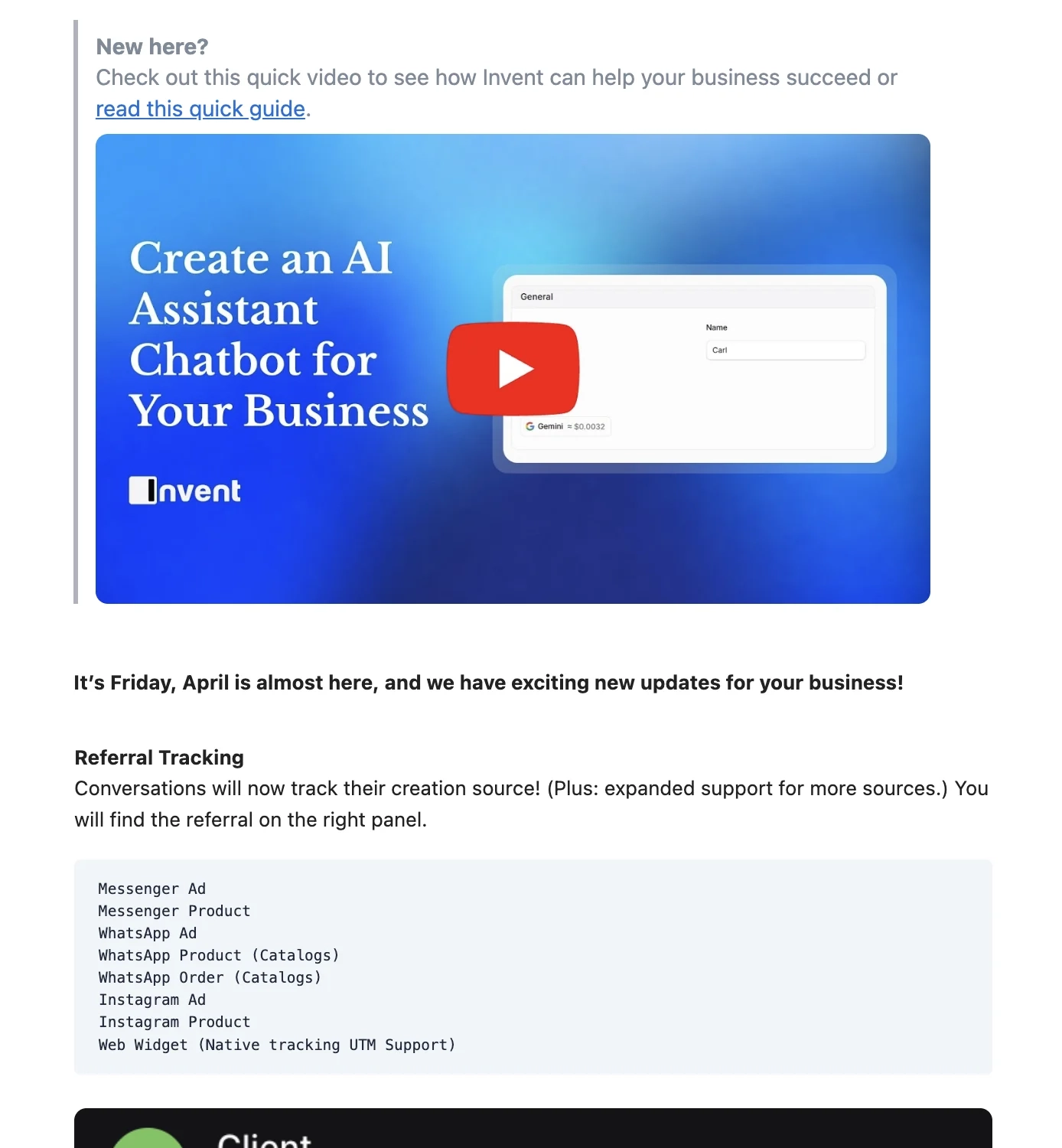
Similar to the previous example, the majority of the newsletter is a roundup of new features and product updates. The last section links to several blog posts about customer satisfaction and engagement.
And here are two examples from VEED. Thank you to Anna Aria Harutyunyan for contributing these.
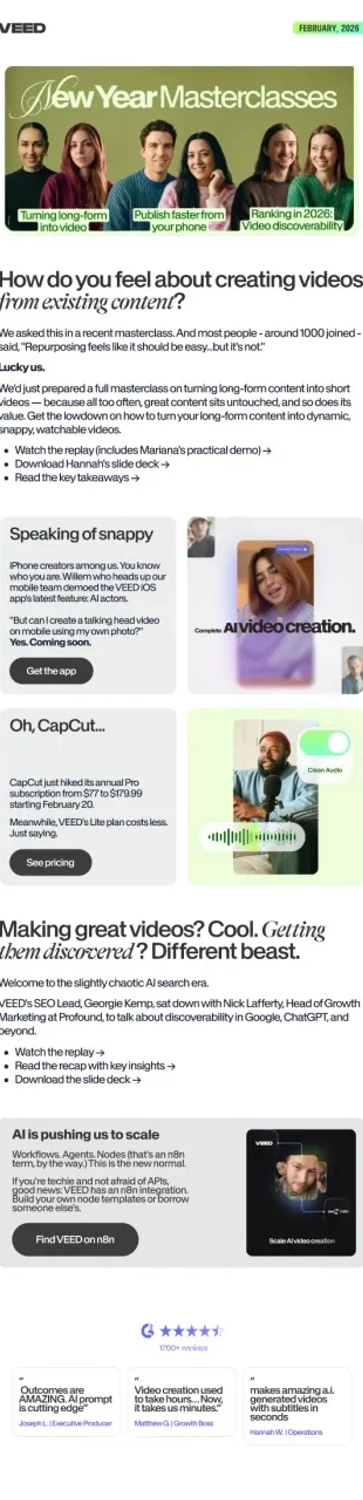
For the February 2026 edition of their newsletter, VEED featured their masterclass about making videos from existing content. This section included links to the masterclass replay, a speaker’s slide deck, and a key takeaways post.
The second section promotes their iPhone app. The third section mentions Capcut’s price increase to promote VEED Lite as a better deal.
The fourth section features their webinar on AI search, which also includes links to the replay, recap of key takeaways, and the guest’s slide deck. This is then followed by a section promoting their n8n integration. The newsletter ends with a section featuring customer testimonials.
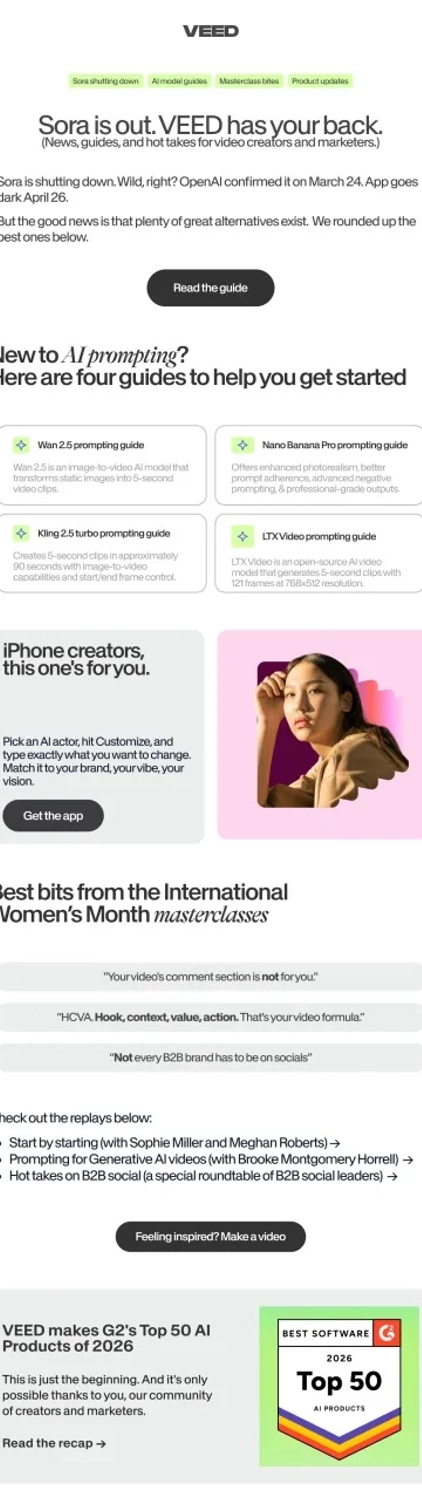
When Sora shut down in early 2026, VEED took the opportunity and promoted their guide on Sora alternatives in one of their newsletters.
The second section of this newsletter features four prompt guides for various AI video models, followed by a CTA section to get their iPhone app. The fourth section shows highlights and replays from their masterclasses during International Women’s Month, with a CTA to make a video at the end.
The last section features social proof for VEED with a link to read the recap.
And here’s Anthropic’s newsletter:
Subject: New: Claude just got a lot more visual
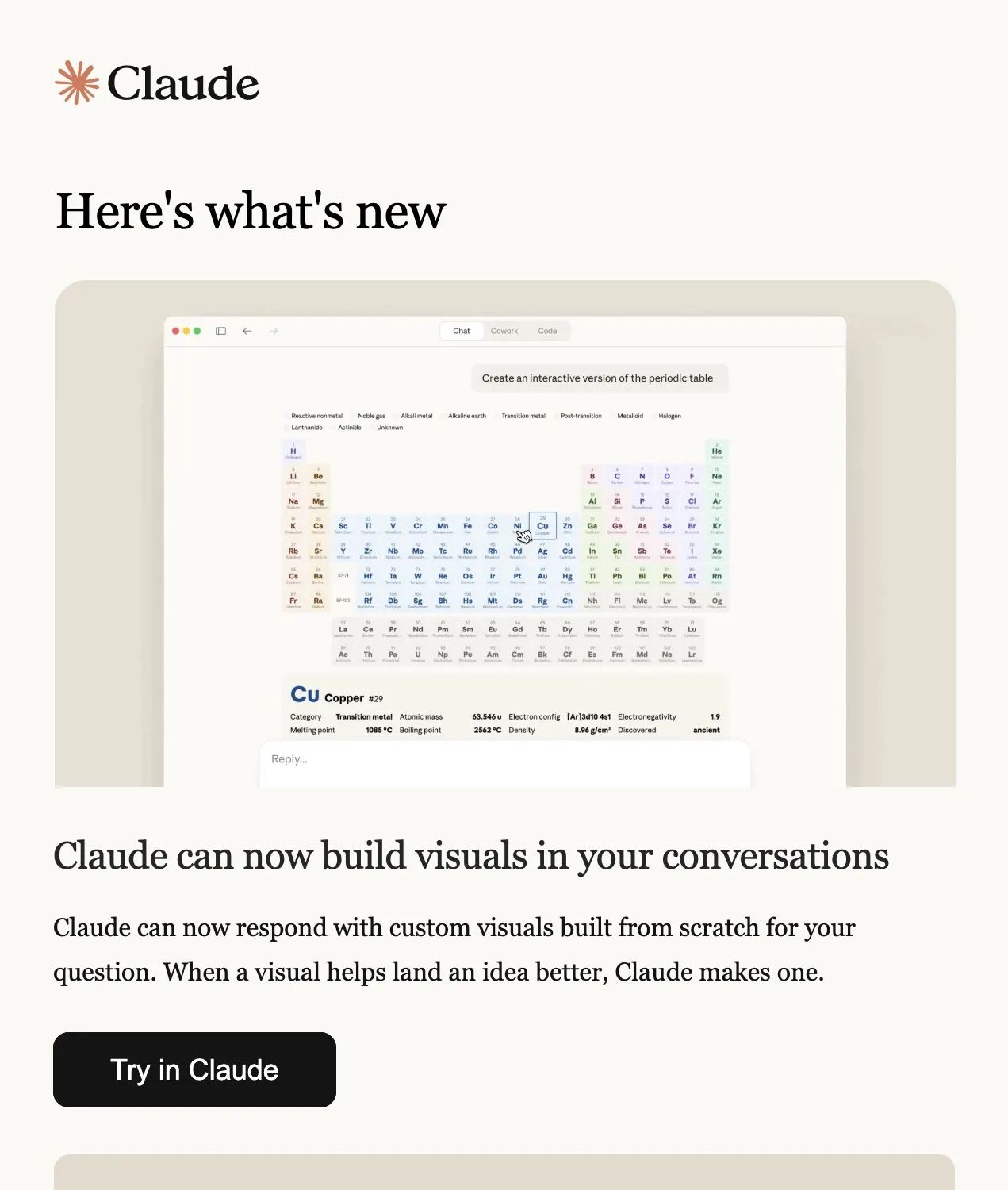
The hero section of the email features Claude’s new image generation capability with a GIF to show exactly what it can do:
This is then followed by a CTA to try the capability in Claude.
The succeeding sections promote importing user data from other AI tools, trying out Cowork, and an invitation to a webinar about using Claude with Excel and Powerpoint.
The newsletter ends with a “Go deeper with Claude” section, which features their Ambassador program and Anthropic Academy courses.
Re-engagement emails
Re-engagement emails nudge inactive users back into the product. Give them a reason to use the product again by including content such as:
- Prompt inspiration
- New features and capabilities
Here’s an example from OpenAI.
Subject: Not sure what to make? Start here
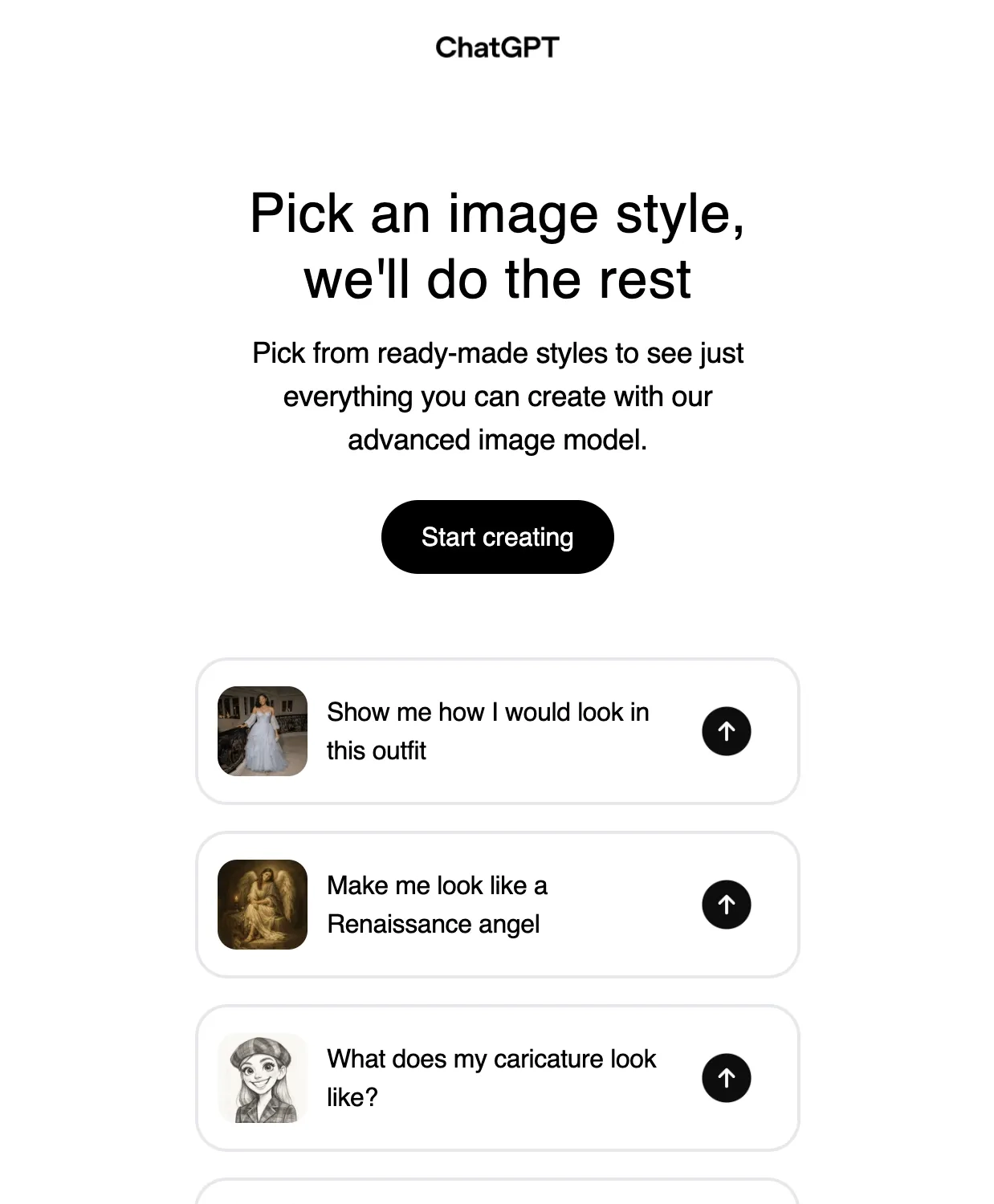
In their re-engagement email, OpenAI lists several ready image prompts to show the user how easy it is to generate images with their AI.
And here’s an example from Google:
Subject: [First name], it’s been a while. Check out what’s new with Gemini
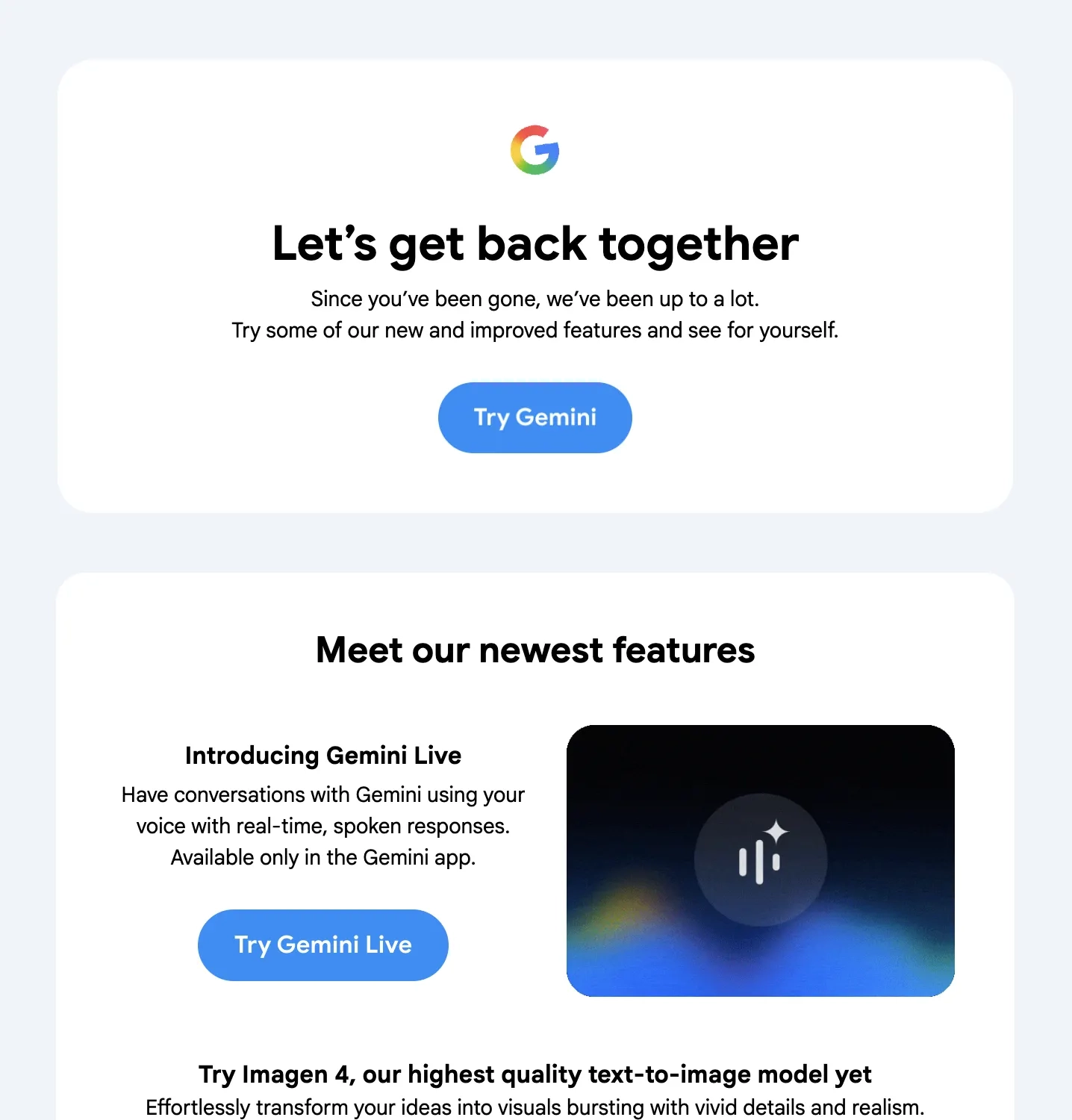
Their re-engagement email starts off by showcasing new features the user might have missed since they last used the platform. The second section highlights several ready made prompts the user can try in Gemini.
Upgrade emails
These emails are sent to users who have been using the product (either on a trial or a free plan), see the product’s value, and are likely ready to purchase a paid plan.
Buying is a big ask so you have to show users the value they’re getting with a paid subscription.
Here’s an example from Perplexity.
Subject: Select your default AI model (from OpenAI, Anthropic, Google, and more)
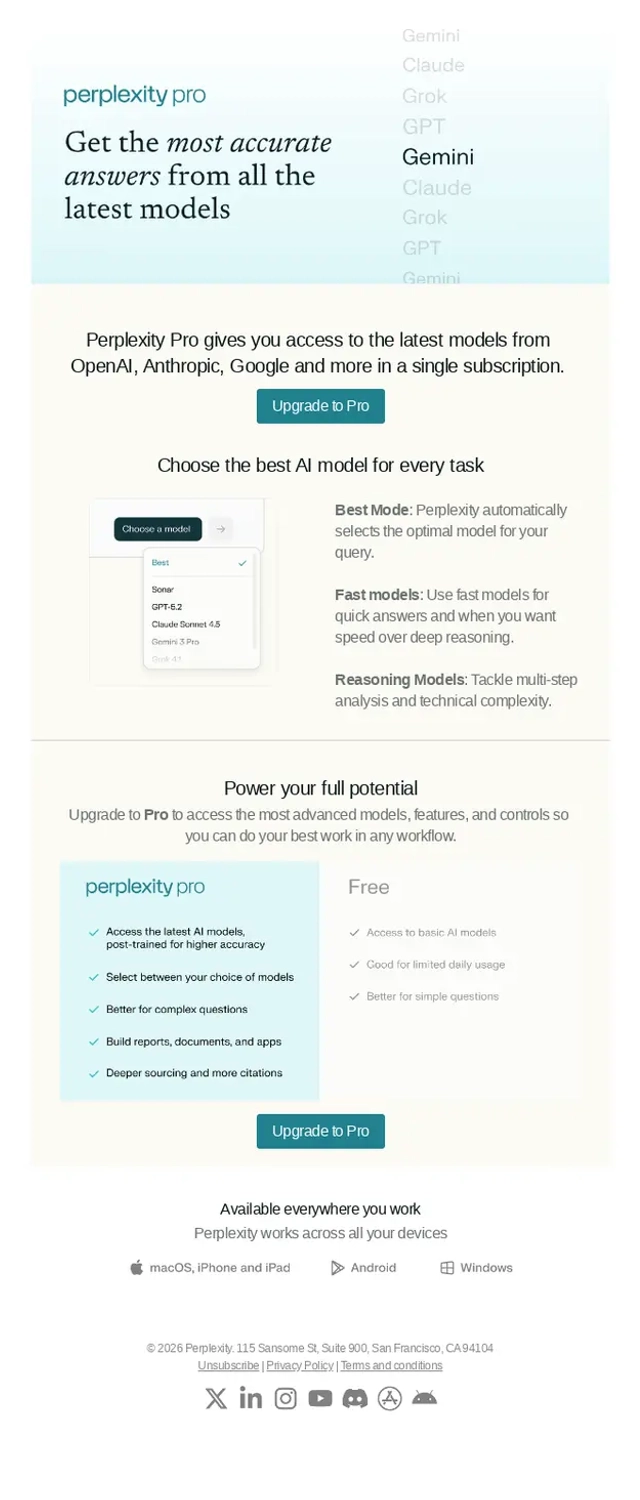
Source: Really Good Emails
Perplexity’s email emphasizes that a paid plan will give the user access to the latest AI models for just a single subscription. The second half of the email shows a comparison table of models, features, and controls between a Pro and Basic plan.
Users also rarely take action with just one email, that’s why upgrade emails are done as a sequence.
Here’s a follow up email from Cursor. Thanks to Benedicte Raae for sharing this example.
Subject: We’re here to help
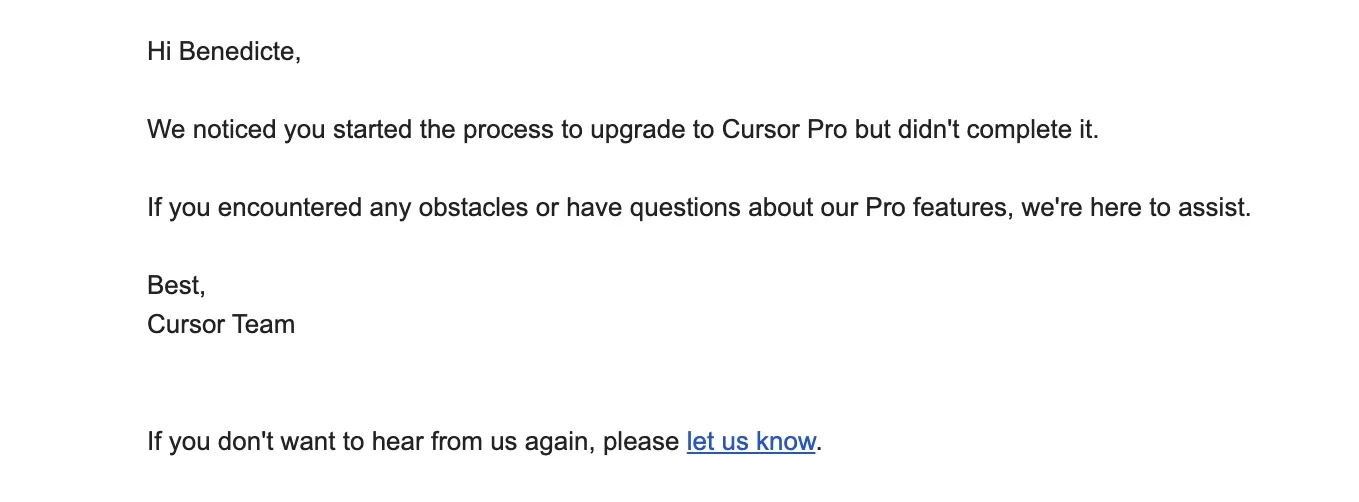
Similar to an abandoned cart emails in ecommerce, Cursor sends this plain text email to follow up with the user after they didn’t push through with the upgrade to Pro.
Discount emails
When leads and users are a bit hesitant to make that purchase, offering promotional discounts on credits or paid plans can get them to convert.
Here’s an example from Krisp:
Subject: Your Krisp trial ends today
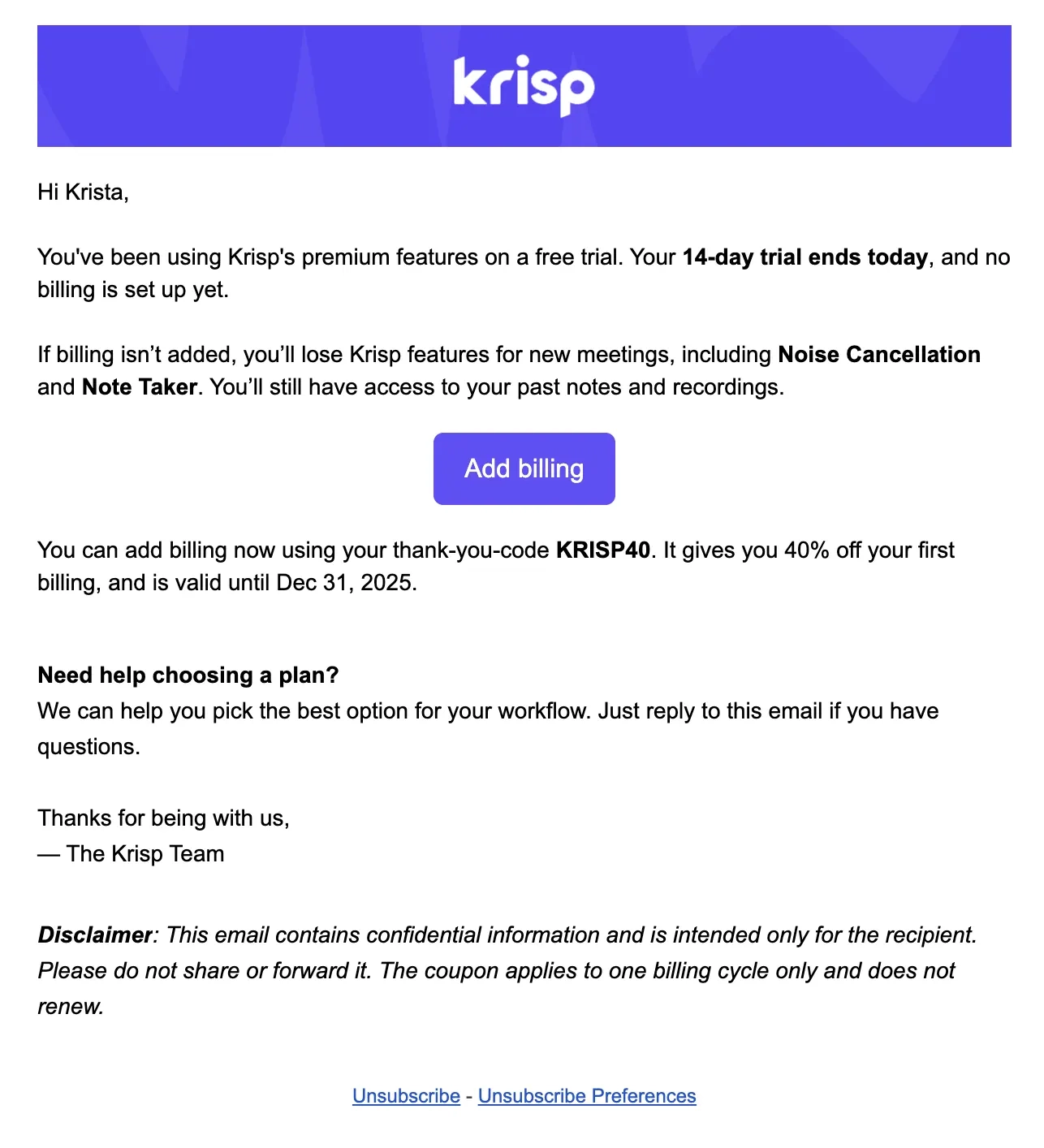
In this trial expiration email, Krisp emphasizes that the user will lose access to premium features such as noise cancellation and note taker if they don’t add a billing method and upgrade.
The second section shares a discount code they can use to get 40% off when the user upgrades. The final section tells the reader that should they need help choosing a plan, they can simply reply to the email.
Here’s Anthropic’s promotional email for an extra usage credit.
Subject: A credit on us, plus discounts on extra usage
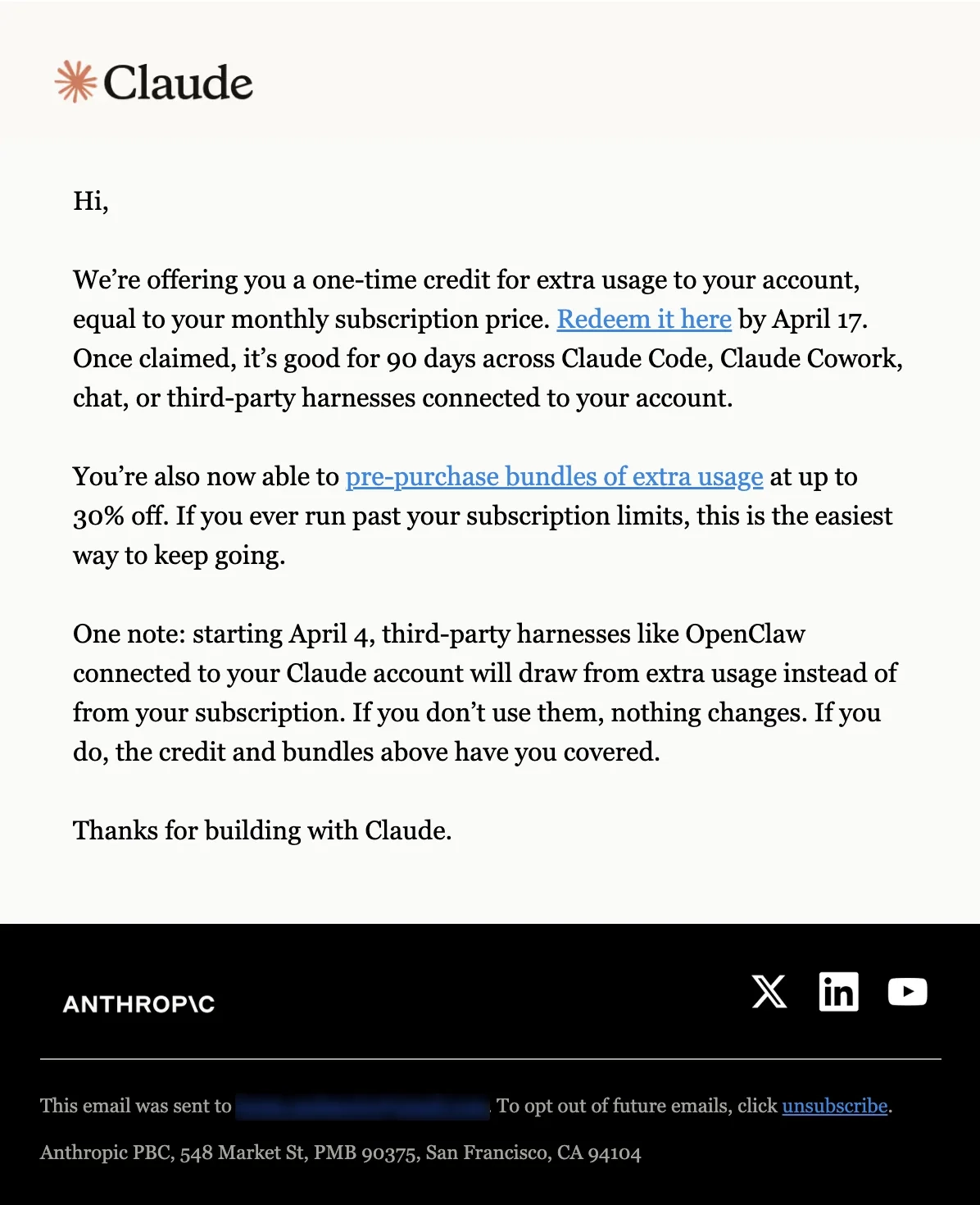
To convince the reader that this is a good deal, Anthropic mentions that the one-time extra usage credit is equal to the monthly Pro subscription price. Anthropic mentions the deal’s deadline, and how long readers can use the credit for.
They present another deal in the second paragraph should the user want to purchase more extra usage credits in the future. The last paragraph mentions that using third party harnesses will draw from extra usage credits, thus it would be a good idea to claim the discounted credit price.
And here’s an example from Lovable.
Subject: Happy Lovable day

Source: Really Good Emails
Lovable ran a promo on Valentine’s day, offering a discount of 50% off on plans, upgrades and top ups. When the user claims this limited time offer, they’ll also receive 50 credits that they can gift to a loved one. The email body ends with a CTA to claim the 50% discount.
The P.S. section mentions important details of the offer such as the validity period and where this discount applies to.
Insights from email marketers
VEED
Anna Aria Harutyunyan, VEED’s senior CRM manager, says that the biggest opportunity for AI SaaS companies is to tap into an audience that genuinely wants to be educated before committing:
“One of the biggest opportunities in email marketing for an AI video company is that your audience genuinely wants to be educated before they commit.
Unlike typical SaaS where a free trial does the selling, AI video tools require users to understand what different models are even capable of producing. Comparative content, think side-by-side outputs of Sora, Veo, Kling, and Fabric 1.0 generated from the same prompt, performs exceptionally well because it answers the question users actually have: ‘What will I get?’ That kind of content earns opens and clicks before a single credit is spent.”
She also shared that prompt guides and workflow walkthroughs are the main content:
“There’s also a strong appetite for practical guidance around prompting and production technique. AI video is still genuinely hard to use well. Users want to know how to write prompts that produce consistent characters across clips, how to string short generations into a coherent narrative, and how to avoid the aesthetic pitfalls that most people now recognize as AI slop. Prompt guides, model release announcements, and workflow walkthroughs are not filler content for this audience. They are the content.”
And model updates are something users actually look forward to:
“Model updates also land differently here than in traditional SaaS. When a new AI video model ships, it is genuinely exciting news, not a changelog. That creates a natural rhythm for email campaigns that keeps engagement high without having to manufacture reasons to reach the inbox.”
However, one major challenge for AI SaaS companies is the cost barrier:
“The main challenge is the cost barrier. AI video credits are expensive, and many users want to see real outputs before they invest.
We address this through free credit offers and educational workshops where we demonstrate the models live. It shifts the value exchange: instead of asking users to take a leap of faith, we show them what is possible first.”
Anna shares that with everything moving fast in the AI SaaS industry, this requires careful curation:
“Selling to AI users is not easier just because they are tech-savvy or enthusiastic about the space. If anything, it requires more discipline. The AI world moves fast, and there is no shortage of news, model releases, and industry updates to talk about every single week. The temptation is to ride that momentum and hit send on everything. That is where you lose people.
The real challenge is curation. AI users are already swimming in content from newsletters, LinkedIn, YouTube, and every other channel. If your emails start to feel like a feed rather than a resource, they will tune out or unsubscribe. I think the brands that earn consistent engagement are the ones that filter ruthlessly, leading with what is actually useful or genuinely new, and skipping the noise.
The sweet spot is a deliberate mix: some broader AI news that gives context to what is happening in the space, real product updates that change what users can do, and practical content that helps them get better results. When you get that balance right, your emails stop feeling like marketing and start feeling like something worth opening. That is the goal regardless of what industry you are in, but with AI users the bar for earning that trust is just a little higher.”
When it comes to email content, she says it all comes down to getting the right mix:
“AI users want a bit of everything, and the mix matters more than any single content type. They want proof that the tool works, which means real outputs, real use cases, and honest comparisons. They want prompt inspiration because even experienced users are still figuring out what is possible. They want to know when models update and what that actually changes for them. And they want benchmarks and technical context that help them make informed decisions about where to spend their time and credits.”
Beyond the inbox, in-person events drive the highest engagement for VEED:
“But what consistently drives the highest engagement goes beyond the inbox. Masterclass invitations, live workshops, and community events perform exceptionally well because they offer something email alone cannot: a chance to see the product in action and ask questions in real time. Competitions and challenges tap into a different motivation entirely. They give users a reason to create, share, and push themselves.
The in-person element is something we have found particularly powerful. Hackathons at our London and Amsterdam offices, where people come in to actually build with VEED, create a level of product connection that no campaign can replicate. Those events generate their own content, their own community moments, and their own word of mouth. Email becomes the thread that ties it all together, inviting people in, following up with outputs and highlights, and keeping the community warm between events.”
Invent
Invent co-founder Alix Gallardo shares that with so many things happening in the product and the industry, it’s challenging to find a balance between building trust and excitement versus overwhelming users with too much information:
“Your audience might range from tech enthusiasts to total beginners, so you have to explain enough about the technology to build trust and excitement, but not overwhelm people with jargon or too technical details.
AI products also evolve pretty fast and keeping users informed without overwhelming them is challenging as we ship something every 2-3 days. We usually send one weekly newsletter to our list.”
From Invent’s experience, users are eager to learn about new features or product updates that can help with their use case:
“Our audience is highly receptive to email communications. Invent is built for business owners who want to stay ahead. Whenever we announce new features or share updates, it’s always with their business success in mind. This means our open rates and CTR are usually high: our users are eager to learn about the latest updates and quick to adopt them to help them grow.”
Alix says that AI SaaS users want to stay in the loop and know what’s changing:
“Each update is designed to help business owners stay ahead of the competition by providing early access to new features, insights, and best practices. The commitment to transparency with them means users always know what’s changing and how it benefits their business, making every email a valuable resource for their growth.”
AuthorityScribe
Auroriele Hans, email strategist and founder of AuthorityScribe, says that AI users have been let down too many times because of hyperbolic claims around AI tools:
“Users are skeptical of AI tools because of hyperbolic marketing claims like, ‘Say goodbye to your copywriter,’ or ‘Replace your humans,’ especially because the reality of using many of these tools is the complete opposite: endless re-prompting and refining. Customers have been let down too many times.”
To get users excited about new AI features, you have to set realistic expectations and handle objections in product announcements:
“Don’t overpromise and handle objections in your product announcements. That’s what I did for a leading headless CMS and composable digital experience platform.
For example, I emphasized that better inputs (customer data pulled from their digital properties) and a brand kit would ensure their outputs were personalized and on-brand. I underscored the time savings of spinning up a first draft that they could then improve upon. Explaining how the product overcame common generative AI issues and setting realistic expectations led to faster adoption and lower churn.”
And just like any industry, being real with users is the best way to sell to them:
“Users are tired of the AI hype. They’ve been sold a ‘magic’ tool, only to be disappointed when they try to use it. Sure, the tools are getting better, but most marketers I talk to still describe the experience of using them as an experiment.
So you have to be real with users — that’s a good rule for selling anything.
Don’t oversell what the product can do. Be empathetic with their frustrating journey with AI. Explain how the product overcomes common AI problems. Future pace what work could look like with the tool. And educate them on how to get the most value out of the platform.”
Auroriele says that users want tons of resources packaged up with empathetic messaging:
“Using AI can feel like the wild west. Playbooks get outdated as soon as they’re written because the tools change so much. Education and support are critical. Most users have a mandate from leadership to use AI. Plus, they want to stand out in a horrible job market. AI companies have to be their trusted sidekicks, guiding and supporting them through a tumultuous user and IRL journey.
That looks like tons of resources — webinars, courses, playbooks — packaged up with empathetic messaging.”
Demand Gen Studio
Demand Gen Studio owner and B2B growth marketer Osnat Lidor that there’s a big opportunity in product updates:
“From my experience, email marketing for product updates is an incredible opportunity for AI-first companies. Most of their target audience feel like they cannot keep up with AI. Product update emails that frame changes as ‘here is what you can now do’ consistently outperform standard updates. You are giving users clarity and excitement about their ability to stay ahead, in an overwhelming space.”
Meanwhile, there’s a challenge to reassure users that the AI SaaS tool won’t go rouge:
“A challenge that is unique to B2B: companies fear the product will go rogue and derail their processes. Assurance is not a footnote in AI communication. Be explicit that updates are not auto-pushed, that guardrails exist, that they stay in control.”
Osnat shares that AI users are more receptive to content that help them go deeper into the tool:
“They are highly receptive to use cases that help them go deeper. Show them how to get more value out of the product, advance their AI usage, they would continue opening the emails and engage. What does not work is generic messaging. They spot it immediately and disengage fast.”
She also says that AI users look for content that helps them stay on top of the technology and the new things they can do with the tool:
“AI users are looking for email content framed around how the product keeps them on the bleeding edge of technology, and what they can now do that was not possible before to them and others.”
Touchstorm DATAlabs
Sangeetha Iyer, marketing lead at Touchstorm DATAlabs, says that email’s role is changing for AI-first companies versus traditional SaaS:
“Email isn’t going to zero for AI-first companies. But its role is changing.
In traditional SaaS, email was a primary growth channel. Onboarding sequences, nurture campaigns, lifecycle marketing, all of it ran through email.
In AI-first companies, a lot of that work is moving into the product itself. AI copilots, real-time personalization, in-product guidance – these are handling things email used to own.
So yes, the volume of email is shrinking. But the importance hasn’t disappeared. It’s just become more specific.”
She adds that email is shifting into a high leverage intervention channel:
“Email is moving from a continuous conversation channel to a high leverage intervention channel. That’s a meaningful difference in how you’d think about what to send and when.
Here’s where AI replaces email pretty cleanly:
- Onboarding. Because the product can now handle that in real time (Claude is the best example I like to quote)
- Nurture sequences are replaced by ongoing product interaction
- Segmentation is replaced by per-user personalization that updates continuously
And here’s where email still wins, and probably always will:
- Re-engagement. When users leave your product, AI can’t follow them. Email can.
- Value reinforcement. AI products often do a lot without communicating it. An email that says “here’s what you got done this week” builds perceived value in a way the product often doesn’t.
- Narrative. AI optimizes individual interactions but it doesn’t tell a coherent story. Email is where you frame the journey, explain the “why” and add a human layer, especially early on.
- Cross-session meaning. Your product sees moments. Email connects them into something the user can understand.”
Sangeetha says that a lot of AI-first companies make the mistake of deciding that they don’t need to send emails:
“A lot of AI-first companies conclude they don’t need email. But what actually happens are weaker activation, poor retention, and no reinforcement of value delivered. Because AI is good at optimizing interactions, not understanding the human behaviour behind the scenes.
The three things email marketing for AI SaaS tools should ideally do:
1. Pull users back into the product.
2. Reinforce the value they’ve already experienced.
3. And expand what they think they can do next.
The best AI companies won’t send more emails. They’ll send less but each one will be triggered-based and tied directly to what the user actually did in the product.”
She shared that while users are becoming less receptive to email marketing, this is a missed opportunity for AI companies:
“Short answer: users are becoming less receptive to email marketing.
As a Claude user, a $23 offer looked very tempting recently but I haven’t received a single email since I became a paid member a month ago. I’m saving Instagram and Linkedin posts for new skills relevant to my role. This is a missed opportunity for AI companies.”
Sangeetha shared that users want to see prompts, model updates, and use case examples in their emails:
“AI tools are often behavior‑driven, so email marketing needs to now shift as a lightweight, automated nudge system. I’m leaning towards prompt based, new model updates, and how that helps users with real scenarios.”
Mighty Fine Copy
Mighty Fine Copy founder Rachael Pilcher shares that one of the challenges for AI companies is defining a specific ‘aha’ moment:
“I think the biggest challenge for me, based on the clients I’ve worked with, is that the ‘aha’ moment for SaaS users tends to be more concrete. But with AI, it isn’t any one specific thing that moves a new user to finding value in the product.
For example in SaaS, your typical ‘aha’ might be the first integration that was connected, or the first invoice that was sent, or whatever. You can easily track that moment, trigger an email, and celebrate this with a user.
But with AI products, it’s not easy to find any specific moment to track. A user might get a better output than they expected on a random day, or solve something they weren’t sure the tool could handle. So there’s nothing concrete to pinpoint, and you’re not always sure what you’re supposed to be guiding users towards as their ‘aha’ moment.”
She shared that AI users are more skeptical so the bar for emails is higher:
“I think AI users are more skeptical of lazy emails. For people who use AI tools every day, the bar for making an email feel like a real human wrote it is higher than it’s ever been. The copy has to feel like it was written for a specific person (or type of person), not populated from a database field, especially if the goal of the email is to sell something.
If your email could have been sent to anyone, an AI user will know it because they could have written it themselves in about 10 seconds.”
From her experience, emails that get the best engagement are the ones about prompt inspiration and model updates:
“A couple of email types I send that get the best engagement are ones that talk about prompt inspiration and model updates, and the ‘why’ behind them. For customers, they make the AI product feel more useful the moment they read those emails.
Prompt emails work because most AI users typically don’t use a tool to its full potential. If they read an email and think ‘Wow, I never thought to use it that way,’ this can be more valuable to them than reading about a new update. But having said that, model update emails get good open rates too because when the model gets better, a customer gets immediate benefit from it.
So for me, emails that can show some kind of before and after situation can give users a reason to go back into the AI tool and try something again, which is more hands-on and nudges people back into the product, versus just sending out news roundups or whatever.”
Fewer emails but more value
While the AI platform can already take over growth and retention strategies like onboarding, this doesn’t mean AI companies should ditch email. Even the largest AI companies still use email to nudge users back into the product so they continue seeing the value in using it.
AI companies might be sending fewer emails compared to SaaS, but this means each email should be intentional and contains more value for the user.
Don’t miss out on new articles. Subscribe to our newsletter and get your monthly dose of SaaS email marketing insights.