

A successful virality strategy carries the promise of exponential growth, that’s not easily achieved with other growth strategies. Your product spreads across the internet like the latest cute cat video.
The best viral loops are built into the product itself. Every time their users did their job, the product reached someone new.
How do you build a viral loop like that? And how do you know it’s working?
We talked to SaaS growth experts to see how they implemented viral loops in their product, what metrics they used to measure virality, how viral loops contributed to product growth, and more.
Meet our growth experts:
- Patrick Thompson, co-founder of Clarify
- Somya Nayak, marketing lead at Intempt
- Bogdan Petrescu, founder of Modern Practice
- Meagan Glenn, founder of Just Fractional
- Siim Kostabi, founder of Pageloot
- Abhishek Shah, founder of Testlify
Don’t wait for the muse. Apply this step-by-step method to write high-performing email campaigns in hours, not weeks.
Virality and viral loops
Before we get into the real world examples, what are virality and viral loops?
Virality is a product-led growth strategy where users help your SaaS acquire new users.
One of the best known examples of virality is Dropbox’s program, where users are rewarded with additional storage space for every friend or family member who signed up to the platform.

These programs involve viral loops, which are the steps your users take to help acquire new users. To illustrate, let’s look at this example from Statuspage:

Their viral loop starts with leads seeing the “Powered by…” banner and restarts when new users create their own pages with the platform.
If you want to know more about how to bake virality into your product, read our conversation with Patrick Thompson.
Types of viral loops and real world examples
Word of mouth
This type of viral loop relies on users telling other people about your product.
Just Fractional founder Meagan Glenn told us how they used word of mouth to grow Prodfolio, a portfolio platform for product managers:
“Other product managers see the portfolio link and ask ‘how did you make this?’ and sign up to the platform.”
Indirect
Indirect viral loops happen when users indirectly expose potential leads to your product while using it.
Meagan added that they also used indirect viral loops for Prodfolio:
“We also had a ‘Built with Prodfolio’ banner on free portfolios so when that banner clicked, the CTA brought new users into the signup funnel.”
Siim Kostabi, founder of Pageloot, took a similar approach for the QR codes generated by free plan users on their platform:
“Our most effective viral loop is baked directly into the product: every QR code generated on a free plan includes a small ‘Created with Pageloot’ label.
When someone scans that code in the real world (i.e. a restaurant menu, a product package, or an event poster) they see the brand. That passive exposure drives a steady stream of organic signups from people who didn’t know us until they scanned someone else’s code.”
Incentivized
This type of viral loop rewards users for inviting leads to your product.
Somya Nayak of Intempt shares how their incentivized viral loop works:
“Every account gets a unique invite link. The invite link is surfaced at the moment a user has just gotten value — right after they ship their first journey or segment – instead of being buried in a settings page nobody opens.”
Intempt’s viral loop involves three steps:
- Act on the in-product prompt that appears after the activation milestone
- Share their unique link, either by sending email invites from inside the product
- The invited person signs up and does the activation event before the reward unlocks
While most incentivized viral loops are monetary, Patrick Thompson shared that there are other ways to do it:
“There are different ways to build in this kind of a notion of incentivized growth loops into your business and it scales depending on whether or not you’re a B2C organization or a B2B organization.
We tried everything from giving away shirts, AWS credit, and trial extensions. In some cases, the incentive can be as simple as a user sharing an achievement they’ve accomplished. So here, we’re not really giving the user anything of monetary value but allowing them to build their own prestige or brand.”
Organic
Organic viral loops happen when users invite others as part of experiencing your product’s core value. The most common example of this is inviting other team members to collaborate on a task or project.
Bogdan Petrescu, founder of Modern Practice, shared how they built this into a SaaS product:
“We introduced the invite after the user had already created something useful inside the product. From there, they could invite someone directly into that specific workspace, report or project. The recipient got an email with context, clicked through and landed directly where they needed to be.”
Testlify’s Abhishek Shah told us how this worked particularly well for them:
“In our case, assessments naturally create this loop because recruiters or hiring teams need to invite candidates to participate. Each assessment sent creates a potential new product touchpoint without requiring a separate acquisition campaign.”
Metrics used to measure virality
Most of the SaaS growth experts we talked to shared that they looked at both email and in-product metrics to measure virality. These help them get a fuller picture of whether or not the viral loop is effective.
Email metrics
For emails, they tracked things such as:
- Invite-accept rate
- Onboarding sequence moving people from signed up to publish
In-product engagement metrics
In-product engagement metrics could be split into two buckets, general and product-specific. General metrics include:
- Invite rate
- Invites per account
- Acceptance rate
- Activation rate of invited users
- Time to value
Meanwhile, product-specific metrics depend on the platform’s features and capabilities such as:
- Signup to publish rate
- Publish to share rate
- Signups attributed to shared portfolio links
- Scan-to-signup attribution
- New scan to new signup ratio
K-factor
Some growth experts look at the K-factor, which is the output metric used to describe the growth rate of products. This essentially makes it the sum of all the viral loops in your product.
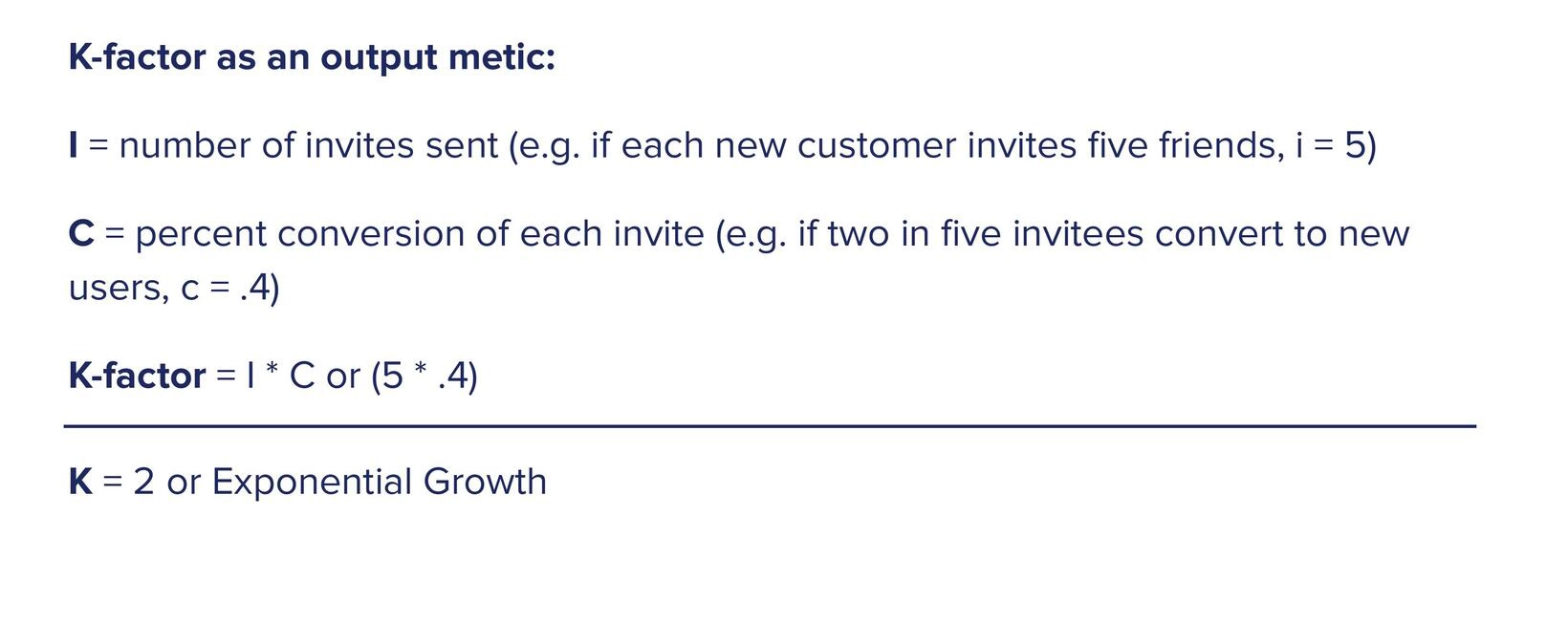
A K-factor of greater than one means your product has exponential growth.
Measuring virality in practice
Measure metrics in the same event stream
Somya said that they monitored email engagement and in-product behavior in the same event stream to optimize for the invite-accept rate:
“The number we actually optimized for was the invite-accept rate rather than opens or clicks since an opened invite that goes nowhere tells you nothing.
The thing that made this work was having email engagement and in-product behaviour in the same event stream. A referrer who opened the reminder but never re-entered the product needs a completely different nudge from one who never opened it at all, and you can only tell those apart if the two data sets are joined.”
Track the full journey
Meanwhile, Bogdan and the Modern Practice team track the full journey. Not only do they look at email and in-product engagement metrics but they also monitor where users drop off:
“We track the full journey, not just email opens and clicks. The main metrics were invite rate, invites per account, acceptance rate, activation rate of invited users and time to value. We also looked at where people dropped off.
For example if clicks were strong but activation was weak, that usually meant the issue was in the product experience after the invite, not in the email itself.”
Measure the loop as a funnel
Meagan’s team at Prodfolio tracked their viral loop as a funnel which helped them attribute new portfolios shared to new signups:
“We tracked the loop as a funnel in Mixpanel.
In-product, we watched signup-to-published rate, publish-to-share rate, and signups attributed to shared portfolio links through referral parameters. For email, we tracked how our onboarding sequence moved people from signed up to published, since we found that the nudges unlocked sharing.
We found that every time a new portfolio was shared, we were able to attribute it back to new signups.”
Monitoring scans and signups
For Pageloot, a QR code generator, the team mainly tracks the scan-to-signup attribution:
“We track what we call scan-to-signup attribution. When someone signs up, we look at whether their first touchpoint was a scan from another user’s QR code.”
Siim also shared that they monitor the ratio of new scans to new signups to determine if their branded label is converting:
“We also monitor the ratio of new scans to new signups on a weekly basis because a spike in scans without a corresponding signup lift usually means our branded label isn’t converting well on certain deployment types.”
Don’t wait for the muse. Apply this step-by-step method to write high-performing email campaigns in hours, not weeks.
How viral loops contribute to product growth
Compounding growth
Most SaaS growth experts we talked to told us that baking viral loops into the product brought compounding growth.
Meagan mentioned that shared portfolios brought new signups for Prodfolio:
“It was a steady, compounding growth channel. Shared portfolios consistently brought in new signups: product managers would see a peer’s portfolio on LinkedIn or in a PM community, ask how they built it, and sign up themselves.”
Siim says that they monitor the K-factor to see how each user’s QR codes generate new users over time:
“The K-factor is the core metric we care about. If each user’s QR codes are generating even 0.3 new users on average, that compounds meaningfully over time when you have hundreds of thousands of codes in the wild across 110 countries.”
Better quality and high intent signups
Aside from new sign ups, growth experts also told us viral loops have brought them better leads. Bogdan shared that this is because referred leads had more context:
“The biggest impact I saw was not just more signups, but better quality signups. Invited users usually came in with much more context and stronger intent because they already knew who invited them and what they were supposed to do inside the product.
That helped shorten the path to activation and created a more natural acquisition channel, where existing product usage was directly bringing in new users.”
Meagan shares why their viral loop brings in high intent leads:
“Those users tended to be high intent because a colleague had already shown them what ‘good’ looks like.”
Referred accounts have higher activation
Somya explains that the gated rewards were responsible for higher activation in referred accounts:
“Referred accounts activated at a noticeably higher rate than any other channel, which we’d attribute to the reward being gated on activation rather than signup.”
Lessons from implementing viral loops
The viral loop only works as well as your activation
During her time with Prodfolio, Meagan learned that the viral loop will only work as well as your activation:
“Early on, most signups never finished a portfolio, so they never had anything to share. As we made it faster to get to a published portfolio with Resume/LinkedIn PDF import, guided frameworks, and email onboarding, more users reached the point where they could share, and the loop had more fuel.
My advice for early-stage SaaS teams: fix activation first because every user who hits the aha moment becomes a potential acquisition channel.”
Use natural collaboration points to build organic viral loops
SaaS products that have natural collaboration points can turn them into organic viral loops.
Bogdan says these made the viral loop feel natural:
“The strongest viral loops I’ve seen in B2B SaaS are usually collaboration loops built into the core product. The idea was simple: instead of asking users to refer someone, we introduced invites at moments where bringing in a teammate, client or stakeholder was already part of the job they were trying to do.
That made the loop feel natural. The user was not ‘referring’ someone, they were just using the product properly.”
Abhishek added that this is a much more sustainable approach instead of asking users to refer people:
“SaaS companies should look for places where their product naturally requires users to collaborate or invite others. That tends to create a much more sustainable viral loop than simply adding a ‘refer a friend’ button.”
Remove unnecessary onboarding friction
Bogdan says removing unnecessary friction lets invited users take meaningful action immediately:
“A big part of our UX work was removing unnecessary onboarding friction for invited users so they could understand the context and take meaningful action as quickly as possible.”
Connect the dots between metrics
Instead of analyzing metrics in silos, read them together to see the bigger picture. For Somya and the Intempt team, this helped them differentiate what nudges users need:
“A referrer who opened the reminder but never re-entered the product needs a completely different nudge from one who never opened it at all. You can only tell those apart if the two data sets are joined.”
Bogdan says this approach helped them pinpoint problems:
“For example, if clicks were strong but activation was weak, that usually meant the issue was in the product experience after the invite, not in the email itself.”
Stories from SaaS growth experts
Intempt
Somya Nayak, marketing lead at Intempt, shares that users only get a unique invite link after they’ve shipped their first journey or segment:
“Every account gets a unique invite link. The invite link is surfaced at the moment a user has just gotten value — right after they ship their first journey or segment – instead of being buried in a settings page nobody opens.”
Intempt’s viral loop involves three steps:
- Act on the in-product prompt that appears after the activation milestone
- Share their unique link, either by sending email invites from inside the product
- The invited person signs up and does the activation event before the reward unlocks
He shared that they looked at email engagement and in-product behaviour in the same event stream to optimize for the invite-accept rate:
“On the email side, the number we actually optimized was the invite-accept rate rather than opens or clicks since an opened invite that goes nowhere tells you nothing.
The thing that made this work was having email engagement and in-product behaviour in the same event stream. A referrer who opened the reminder but never re-entered the product needs a completely different nudge from one who never opened it at all. You can only tell those apart if the two data sets are joined.”
“Referral grew a percentage of new signups, and referred accounts activated at a noticeably higher rate than any other channel which we’d attribute to the reward being gated on activation rather than signup.”
Modern Practice
Modern Practice founder Bogdan Petrescu says that they made viral loops natural by letting users invite collaborators or teammates when it was part of the task they were trying to accomplish:
“The strongest viral loops I’ve seen in B2B SaaS are usually collaboration loops built into the core product. The idea was simple: instead of asking users to refer someone, we introduced invites at moments where bringing in a teammate, client or stakeholder was already part of the job they were trying to do.
That made the loop feel natural. The user was not ‘referring’ someone, they were just using the product properly.”
Bogdan shares that they only let users invite their teammates or collaborators after they’ve already created something useful inside the product:
“We introduced the invite after the user had already created something useful inside the product. From there, they could invite someone directly into that specific workspace, report or project. The recipient got an email with context, clicked through and landed directly where they needed to be.
A big part of the UX work was removing unnecessary onboarding friction for invited users so they could understand the context and take meaningful action as quickly as possible.”
He and his team track the full journey and look at several metrics to measure virality:
“We tracked the full journey, not just email opens and clicks. The main metrics were invite rate, invites per account, acceptance rate, activation rate of invited users and time to value, also looked at where people dropped off.
For example if clicks were strong but activation was weak, that usually meant the issue was in the product experience after the invite, not in the email itself.”
Bogdan says that aside from increase in signups, viral loops have helped acquire better quality signups:
“The biggest impact I saw was not just more signups, but better quality signups. Invited users usually came in with much more context and stronger intent because they already knew who invited them and what they were supposed to do inside the product.
That helped shorten the path to activation and created a more natural acquisition channel, where existing product usage was directly bringing in new users.”
Just Fractional
Meagan Glenn, founder of Just Fractional, shares how they baked in the viral loop into Prodfolio’s core use case:
“At Prodfolio, a portfolio platform for product managers I co-founded, the loop was built into the core use case.
Product managers created case studies that showed how they think, then share their portfolio link on LinkedIn or send it directly to hiring managers and recruiters. Every shared portfolio put the product in front of other product people, who were exactly our audience. Email supported the loop by nudging users back to finish and publish, so we had an onboarding campaign specifically.”
Prodfolio’s viral loop consisted of five steps:
- A product manager signed up and imported their resume or PDF of their LinkedIn profile, so they didn’t start from a blank page.
- They build a case study using a guided framework.
- They published their portfolio.
- They shared the link on LinkedIn, in applications for new jobs, or in PM communities.
- Other PMs see it, or ask ‘how did you make this?’, and sign up. We also had a “Built with Prodfolio” banner on free portfolios, so when that banner was clicked the CTA brought new users into the signup funnel.
She shared that they tracked the viral loop as a funnel in Mixpanel and monitored both email and in-product metrics:
“We tracked the loop as a funnel in Mixpanel.
In-product, we watched signup-to-published rate, publish-to-share rate, and signups attributed to shared portfolio links through referral parameters.
For email, we tracked how our onboarding sequence moved people from signed up to published, since we found that the nudges unlocked sharing. We found that every time a new portfolio was shared, we were able to attribute it back to new signups.”
Meagan shares that their viral loops brought Prodfolio steady and compounding growth:
“The loop didn’t 10x us overnight, but it was a steady, compounding growth channel. Shared portfolios consistently brought in new signups: product managers would see a peer’s portfolio on LinkedIn or in a PM community, ask how they built it, and sign up themselves.
Those users also tended to be high-intent, because a colleague had already shown them what ‘good’ looks like. We also found Reddit to be a viable channel for sharing.”
She also shared a tip for early stage SaaS businesses who want to try viral loops:
“The biggest lesson was that the loop only works as well as your activation. Early on, most signups never finished a portfolio, so they never had anything to share. As we made it faster to get to a published portfolio with Resume/LinkedIn PDF import, guided frameworks, and email onboarding, more users reached the point where they could share, and the loop had more fuel.
My advice for early-stage SaaS teams: fix activation first, because every user who hits the aha moment becomes a potential acquisition channel.”
Pageloot
Pageloot founder Siim Kostabi told us that including a “Created with” banner on the QR codes generated by their platform helped them acquire more signups:
“Our most effective viral loop is baked directly into the product: every QR code generated on a free plan includes a small ‘Created with Pageloot’ label.
When someone scans that code in the real world, a restaurant menu, a product package, an event poster, they see the brand. That passive exposure drives a steady stream of organic signups from people who didn’t know us until they scanned someone else’s code.”
He adds that the product does most of the heavy lifting for their viral loop:
“The steps are pretty simple. A user creates a QR code, deploys it in a physical context, other people scan it, some percentage of those scanners become users themselves. No referral program needed, no email nudges. The product just does the work.”
Siim shares that they track the scan-to-sign up attribution to measure virality:
“For measuring virality, we track what we call scan-to-signup attribution. When someone signs up, we look at whether their first touchpoint was a scan from another user’s QR code.
We also monitor the ratio of new scans to new signups on a weekly basis because a spike in scans without a corresponding signup lift usually means our branded label isn’t converting well on certain deployment types.”
They also monitor the K-factor to see how growth compounds over time:
“The K-factor is the core metric we care about. If each user’s QR codes are generating even 0.3 new users on average, that compounds meaningfully over time when you have hundreds of thousands of codes in the wild across 110 countries.”
Testlify
Abhishek Shah, founder of Testlify, says that their viral loop worked particularly well because it was natural for a user to bring in another person into the product:
“At Testlify, we’ve seen product-led growth work particularly well when users have a natural reason to bring another person into the product.
In our case, assessments naturally create this loop because recruiters or hiring teams need to invite candidates to participate. Each assessment sent creates a potential new product touchpoint without requiring a separate acquisition campaign.”
He shares the steps involved in their viral loop:
“A recruiter creates an assessment and shares it with a candidate. The candidate interacts with the assessment, which creates another product touchpoint and can introduce the experience to other stakeholders involved in hiring. The important part is that the sharing is built into the core workflow rather than being an additional action users have to take purely for referral purposes.”
Testlify describes how different metrics have helped them assess leads:
“We looked at product engagement around assessment invitations and candidate participation, along with the conversion of those interactions into further product activity. Email engagement was particularly useful for understanding whether invitations were being opened and acted upon. In-product activity then helped us distinguish between someone simply receiving an invitation and someone actually engaging with the product.”
Abhishek emphasized that SaaS businesses should look for natural collaboration points if they want to create a more sustainable viral loop:
“The biggest value was that the product itself became part of the acquisition motion. Every assessment invitation could introduce Testlify to someone who had not previously interacted with the platform, creating a repeatable acquisition channel within the hiring workflow.
The broader lesson is that SaaS companies should look for places where their product naturally requires users to collaborate or invite others. That tends to create a much more sustainable viral loop than simply adding a ‘refer a friend’ button.”
Let users help with your SaaS growth
Happy users become your advocates and can help grow your customer base. Whether it’s users are raving about your product on social media or community pages or an invitation to their colleagues, viral loops can be a steady customer acquisition channel.
We encourage you to try out different strategies so you can find out which viral loops work best for your SaaS.
Don’t miss out on new articles. Subscribe to our newsletter and get your monthly dose of SaaS email marketing insights.